



























Easter Bunny Tracing & Directions | Essential K-2 Worksheet
Paste this activity's link or code into your existing LMS (Google Classroom, Canvas, Teams, Schoology, Moodle, etc.).
Students can open and work on the activity right away, with no student login required.
You'll still be able to track student progress and results from your teacher account.
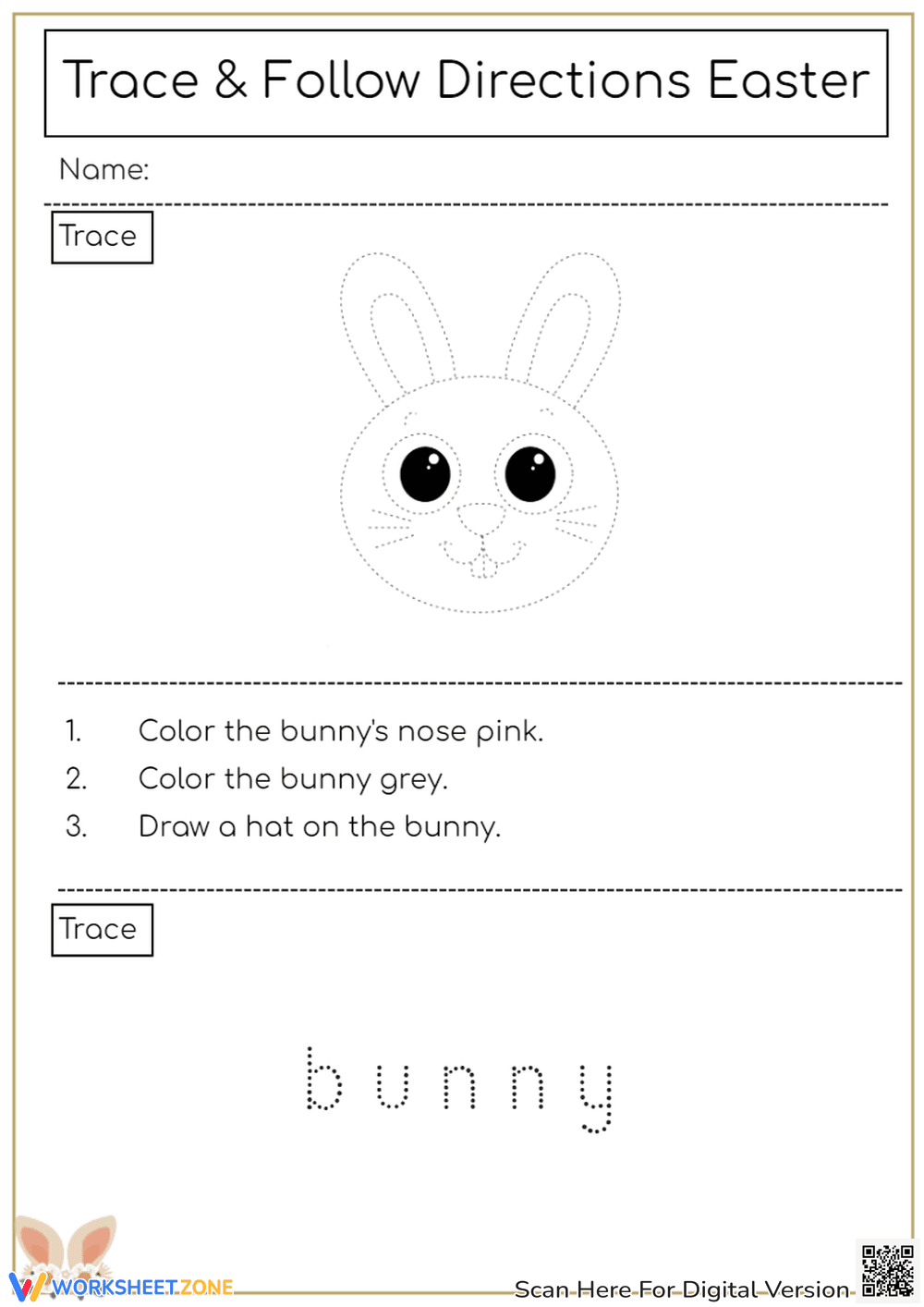
This Kindergarten Easter Bunny worksheet combines fine motor practice with reading comprehension. Students develop hand-eye coordination by tracing a bunny silhouette and the word "bunny" while demonstrating their ability to follow multi-step written instructions. It provides a festive, engaging way to assess foundational literacy and artistic expression in early childhood classrooms.
At a Glance
- Grade: Kindergarten · Subject: ELA & Fine Motor
- Standard:
CCSS.ELA-LITERACY.L.K.1.A— Print many upper- and lowercase letters and follow simple instructions- Skill Focus: Tracing and Following Directions
- Format: 1 page · 5 tasks · No answer key needed · PDF
- Best For: Morning work or holiday centers
- Time: 10–15 minutes
Inside this single-page PDF, you will find a large, dotted-line bunny face ready for tracing. Below the image, three specific numbered directions guide students to color the nose pink, color the bunny grey, and draw a hat. The page concludes with a word-tracing exercise for the word "bunny," reinforcing letter formation and vocabulary recognition through tactile repetition.
This resource is designed for a zero-prep workflow. First, print the single-page PDF (30 seconds). Second, distribute the sheets to students along with crayons or colored pencils (1 minute). Third, review the completed work by checking for accuracy in following the three specific coloring and drawing prompts (30 seconds per student). Total teacher preparation time is under two minutes, making it an ideal sub plan or transition activity.
This worksheet aligns with CCSS.ELA-LITERACY.L.K.1.A, focusing on the formation of letters through tracing. It also supports CCSS.ELA-LITERACY.RI.K.10 by requiring students to engage with text to follow specific procedural steps. Both standard codes can be copied directly into lesson plans, IEP goals, or district curriculum mapping tools to ensure compliance with state and national frameworks.
Use this as a "bell-ringer" activity during the week leading up to Easter to settle students as they arrive. It also serves as an excellent formative assessment for listening or reading comprehension; observe if students can independently follow the three-step instructions without teacher prompting. Expect completion within 15 minutes depending on the student's fine motor speed and attention to detail.
This is ideal for Kindergarten and 1st-grade students who are mastering pencil control. It provides necessary scaffolding for learners with fine motor delays or those requiring visual cues to stay on task. Pair this with a read-aloud about spring or an anchor chart showing color words to support emerging readers as they navigate the instructions.
Research from Fisher & Frey (2014) emphasizes the importance of the gradual release of responsibility, where simple tracing and following directions serve as foundational scaffolds for early literacy. This worksheet targets CCSS.ELA-LITERACY.L.K.1.A by integrating letter formation with functional reading tasks. By requiring students to translate written text into physical actions—such as coloring a specific area a specific color—the activity reinforces the connection between decoding and meaning. According to the RAND AIRS 2024 report, integrating holiday-themed content can increase student engagement by up to 22% in early elementary settings. This resource provides a structured environment for students to practice 5 distinct tasks, including tracing and drawing, which are critical for developing the intrinsic hand muscles required for later writing fluency. It is a practical tool for any early childhood educator seeking to combine seasonal fun with rigorous standards-based skill development.


