































The Wampanoag and the Pilgrims: 1621 Harvest Reading Comprehension | Grade 3

Paste this activity's link or code into your existing LMS (Google Classroom, Canvas, Teams, Schoology, Moodle, etc.).
Students can open and work on the activity right away, with no student login required.
You'll still be able to track student progress and results from your teacher account.
Build accurate historical knowledge and reading stamina with this Grade 3 social studies worksheet. Students examine the historical relationship between the Wampanoag and Pilgrims during the 1621 harvest gathering, answering text-dependent questions and defining key vocabulary. This resource develops critical nonfiction comprehension while providing students with an evidence-based perspective on early American history.
At a Glance
- Grade: Grade 3 · Subject: Social Studies
- Standard: Grade 3 History — Read informational texts to explain key historical events and cultural traditions
- Skill Focus: 1621 Harvest Gathering and Wampanoag History
- Format: 3 pages · 9 problems · Answer key included · PDF
- Best For: Informational reading comprehension and Thanksgiving units
- Time: 25–35 minutes
What's Inside
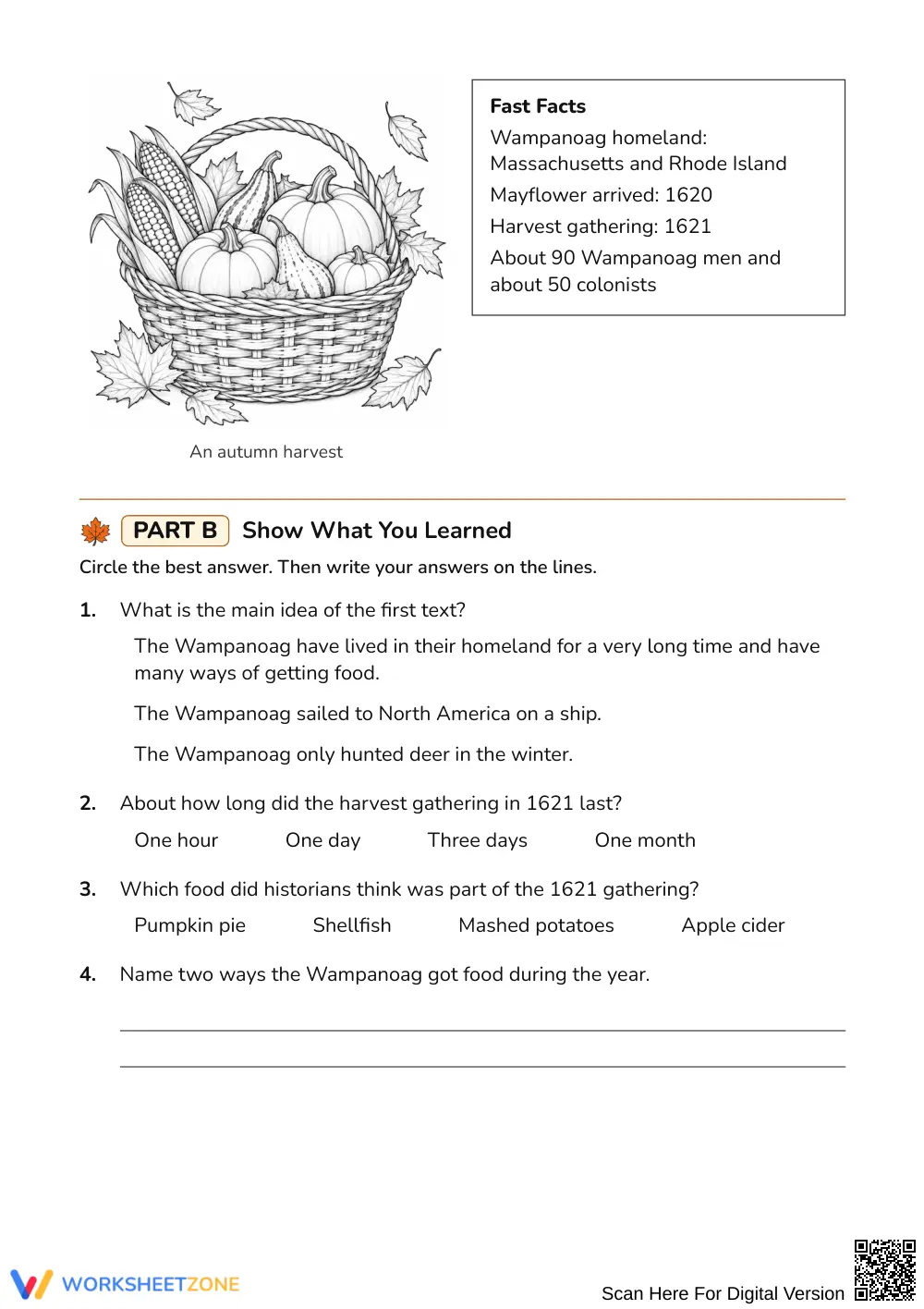
This 3-page printable resource includes a two-part informational text, a captioned harvest image, and a Fast Facts box. Across Parts B and C, students complete 9 tasks: 3 multiple-choice questions, 2 text-based short-answer questions, and a 4-term vocabulary match. A 3-page answer key provides complete model responses.
Skill Progression
This activity follows an intentional progression from guided orientation to independent analysis:
- Guided practice: Students explore the dual-passage text alongside the Fast Facts box and illustration to build context.
- Supported practice: Tasks 1–3 provide structured multiple-choice questions focusing on main ideas and key historical details.
- Independent practice: Tasks 4–9 challenge learners to write text-supported responses and match domain vocabulary terms like sachem and colony.
This progression embodies the gradual-release model, moving students from supported exploration to independent synthesis.
Standards Alignment
This resource aligns with Grade 3 informational reading and social studies standards focused on asking and answering questions to demonstrate understanding of historical texts, citing explicit details, and determining the meaning of domain-specific words. Both standards can be copied directly into lesson plans, IEP goals, or district curriculum mapping tools.
How to Use It
Implement this worksheet during a guided reading group or as a mid-unit social studies check after direct instruction on early colonial America. Alternatively, assign it as an independent reading response task during November history rotations. For formative assessment, observe whether students reference the Fast Facts box or return directly to paragraph two to verify the duration and attendee count of the 1621 gathering. Typical completion takes 25 to 35 minutes.
Who It's For
This worksheet serves general education third graders exploring indigenous history and colonial settlements. It offers visual and textual supports for English learners through phonetic pronunciation guides and structured fact boxes. Pair this activity directly with a primary source map of seventeenth-century Wampanoag territories or an anchor chart highlighting seasonal agriculture to deepen conceptual understanding.
Integrating domain-specific informational texts with direct vocabulary instruction significantly enhances reading comprehension and content retention for upper elementary students. Research by Fisher & Frey (2014) confirms that the gradual-release framework accelerates reading mastery when students encounter scaffolded text structures, explicit domain-specific terminology, and structured evidence-based questioning. This Grade 3 social studies worksheet operationalizes these evidence-based principles through an accurate historical account of the 1621 harvest gathering between the Wampanoag and English settlers. By pairing structured multiple-choice verification with open-ended written responses and vocabulary matching, the 9 targeted tasks guide learners to extract explicit details, identify seasonal agricultural practices, and examine authentic historical collaboration. Educators utilizing this instructional resource provide balanced, culturally responsive history instruction that builds critical historical literacy, strengthens analytical comprehension skills, and reinforces standard informational reading benchmarks across elementary social studies classrooms.


