


























Views
Downloads
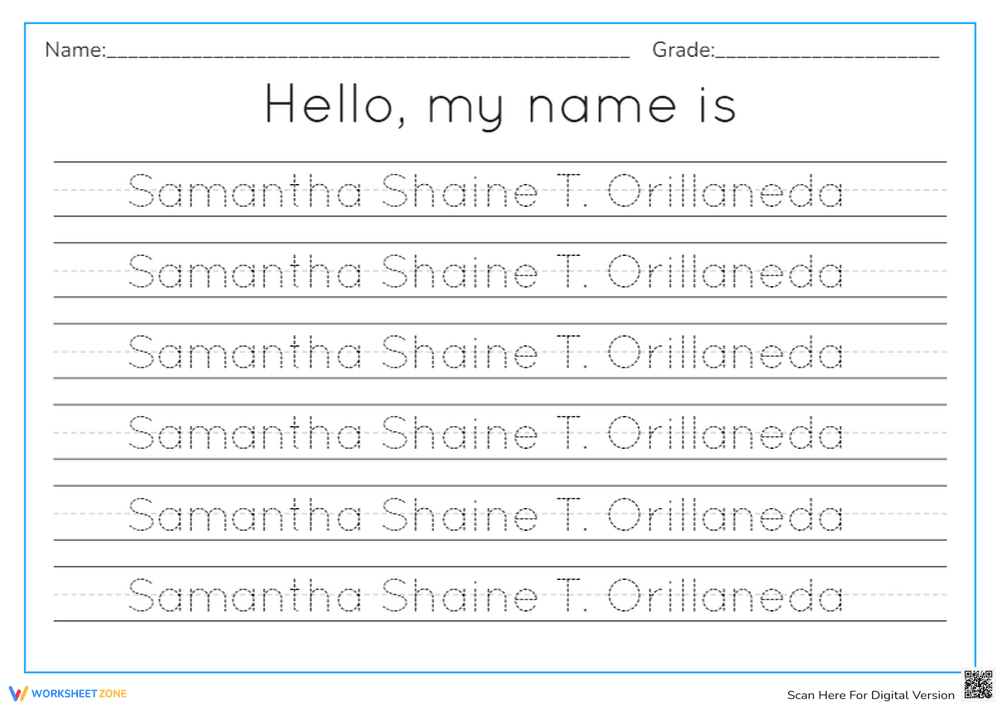

Name Tracing Worksheet | Grade K-1 Printable
Paste this activity's link or code into your existing LMS (Google Classroom, Canvas, Teams, Schoology, Moodle, etc.).
Students can open and work on the activity right away, with no student login required.
You'll still be able to track student progress and results from your teacher account.
This Kindergarten and Grade 1 name tracing worksheet provides immediate practice for students learning to master letter formation and personal identification. By tracing the specific name "Samantha Shaine T. Orillaneda," learners develop the muscle memory required for fluid handwriting while reinforcing the recognition of uppercase and lowercase characters.
At a Glance
- Grade: K-1 · Subject: Handwriting
- Standard:
CCSS.ELA-LITERACY.L.K.1.A— Print many upper- and lowercase letters accurately- Skill Focus: Name Tracing & Letter Formation
- Format: 1 page · 6 tasks · No answer key needed · PDF
- Best For: Morning work or handwriting centers
- Time: 5–10 minutes
This single-page PDF features six identical lines of dotted-line text designed for high-repetition tracing. The layout includes a header for the student's name and grade, followed by a friendly "Hello, my name is" introduction. The large, clear font is specifically chosen to support early learners who are still developing fine motor control and spatial awareness on lined paper.
The workflow for this resource is designed for maximum efficiency in busy classrooms. First, print the required number of copies (30 seconds). Second, distribute the sheets during morning arrival or as a transition activity (1 minute). Third, provide a quick visual review of student grip and stroke order as they complete the six lines (ongoing). Total teacher preparation time is under 2 minutes, making it an ideal sub-plan addition.
This resource aligns directly with CCSS.ELA-LITERACY.L.K.1.A, which requires students to print many upper- and lowercase letters. By focusing on a full name, students practice a variety of letter shapes and the transition between capital and small letters. This standard code can be copied directly into lesson plans, IEP goals, or district curriculum mapping tools.
Use this worksheet during the first week of school as a "getting to know you" activity or as a consistent morning work staple. It serves as an excellent formative assessment tool; observe if students start their letters from the top or bottom to identify who needs additional direct instruction. Completion typically takes 5 to 10 minutes depending on the student's motor skill level.
This practice page is ideal for preschoolers, kindergarteners, and first graders who need repetitive practice with specific letter strings. It is particularly helpful for students requiring Tier 2 handwriting intervention. Pair this with a tactile alphabet anchor chart or a "sky-writing" direct instruction lesson to reinforce the letter shapes before students put pencil to paper.
Handwriting remains a foundational literacy skill, as research from Fisher & Frey (2014) emphasizes that the physical act of letter formation is linked to better letter recognition and reading fluency. This worksheet addresses CCSS.ELA-LITERACY.L.K.1.A by providing 6 lines of structured tracing practice, allowing students to internalize the specific strokes required for both uppercase and lowercase letters. According to the RAND AIRS 2024 report, high-frequency, low-stakes tracing activities in early childhood settings significantly improve fine motor precision and prepare students for independent composition. By focusing on a specific name, the resource increases student engagement through personalization while meeting core language standards. This printable PDF is a reliable tool for educators looking to integrate evidence-based handwriting routines into their daily schedule without increasing prep time.


