


























Views
Plays

Author's Purpose Worksheet | Grade 2 Essential
Paste this activity's link or code into your existing LMS (Google Classroom, Canvas, Teams, Schoology, Moodle, etc.).
Students can open and work on the activity right away, with no student login required.
You'll still be able to track student progress and results from your teacher account.
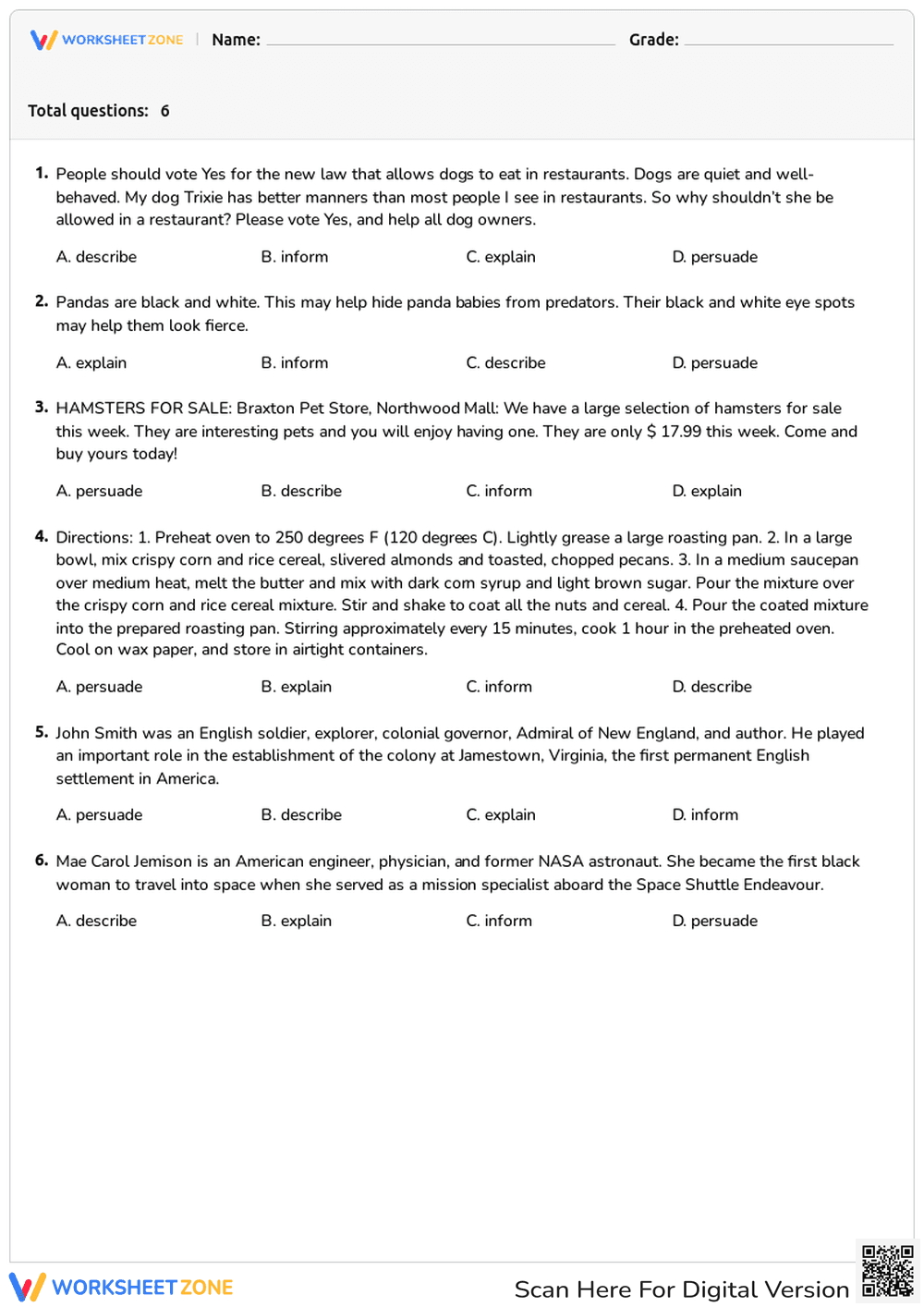
Determining the author's intent is a critical step in developing informational literacy. This Grade 2 Social Studies and ELA worksheet helps students distinguish between four primary purposes: to inform, persuade, explain, or describe. By engaging with short, high-interest passages, learners practice identifying the specific goals behind different types of writing, from historical accounts to persuasive advertisements.
At a Glance
- Grade: 2 · Subject: Social Studies
- Standard:
CCSS.ELA-LITERACY.RI.2.6— Identify the main purpose of a text and what the author wants to explain.- Skill Focus: Author's Purpose (PIED)
- Format: 1 page · 6 problems · Answer key included · PDF
- Best For: Quick formative assessment or literacy centers
- Time: 10–15 minutes
The worksheet features 6 targeted multiple-choice questions. Each question presents a unique nonfiction snippet, including a biography of astronaut Mae Jemison, a persuasive ad for a pet store, and a procedural recipe. This variety ensures students apply their knowledge across different genres. The clear layout and consistent four-option choice structure minimize cognitive load, allowing students to focus entirely on the text analysis.
This resource is designed for a seamless classroom experience. First, print the single-page PDF (30 seconds). Second, distribute the worksheet during your ELA block or Social Studies rotation (1 minute). Third, review the six questions as a whole group or use the included answer key for rapid grading (5 minutes). Total teacher preparation time is under 2 minutes, making this an ideal solution for emergency sub plans or unexpected schedule shifts.
This resource aligns with CCSS.ELA-LITERACY.RI.2.6: "Identify the main purpose of a text, including what the author wants to answer, explain, or describe." It also supports Grade 3 standards regarding point of view. Both standard codes can be copied directly into lesson plans, IEP goals, or district curriculum mapping tools.
Use this worksheet as an exit ticket after a direct instruction lesson on the "PIED" (Persuade, Inform, Entertain, Describe) acronym. Observe if students struggle to differentiate between "inform" and "explain," which is a common hurdle at this level. It also works well as a warm-up activity to activate prior knowledge before starting a unit on historical figures or scientific discovery.
This activity is tailored for 2nd-grade students but provides excellent review for 3rd graders or scaffolded support for 1st graders. It is particularly effective for English Language Learners (ELLs) who benefit from the short, context-rich passages and predictable question format. Pair this with a graphic organizer or an anchor chart for maximum instructional impact.
According to research by Fisher & Frey (2014), the ability to identify an author's purpose is a foundational component of close reading and critical literacy. This worksheet targets CCSS.ELA-LITERACY.RI.2.6 by requiring students to distinguish between texts meant to inform, persuade, explain, or describe. By analyzing 6 distinct nonfiction passages—ranging from historical biographies of John Smith and Mae Jemison to functional texts like recipes—students develop the metacognitive skills necessary to evaluate text intent. This practice is essential for transitioning from "learning to read" to "reading to learn," as it helps students recognize how language is used to influence or educate an audience. The structured multiple-choice format provides immediate data for teachers to identify misconceptions in rhetorical analysis. Integrating these skills within a Social Studies context reinforces the importance of perspective in historical and scientific reporting, ensuring students are prepared for the increased complexity of informational texts.


