


























Views
Plays

Homographs Worksheet | Grade 2 Essential Grammar
Paste this activity's link or code into your existing LMS (Google Classroom, Canvas, Teams, Schoology, Moodle, etc.).
Students can open and work on the activity right away, with no student login required.
You'll still be able to track student progress and results from your teacher account.
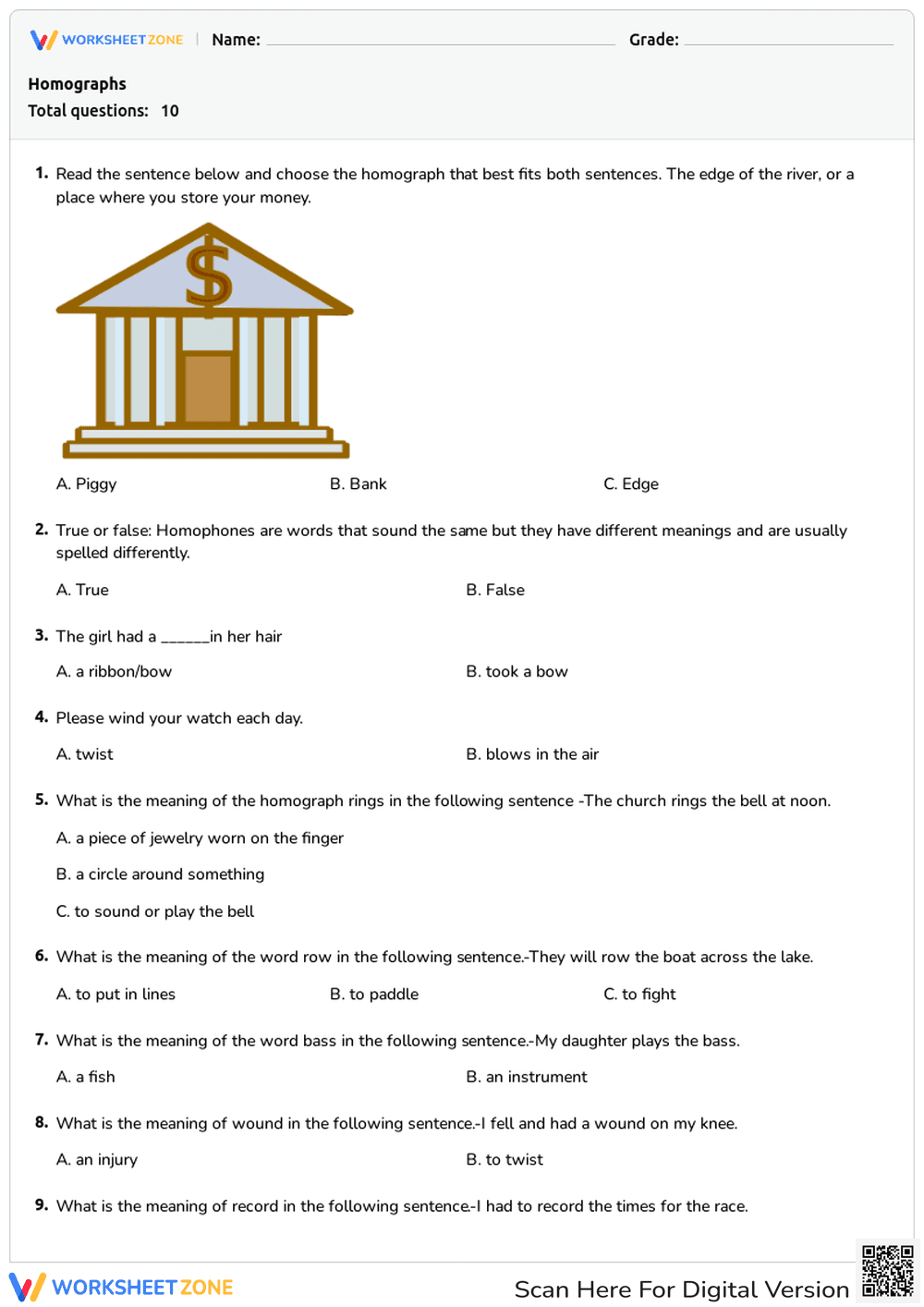
This Grade 2 homographs worksheet helps students distinguish between words that are spelled the same but have different meanings. By analyzing 10 specific examples in context, learners develop the critical linguistic skill of using surrounding text to determine the correct definition of a multiple-meaning word before applying it to their own writing.
At a Glance
- Grade: 2 · Subject: ELA
- Standard:
L.2.4— Use context to determine the meaning of multiple-meaning words- Skill Focus: Homographs and Context Clues
- Format: 2 pages · 10 problems · Answer key included · PDF
- Best For: Quick formative assessment or grammar review
- Time: 15–20 minutes
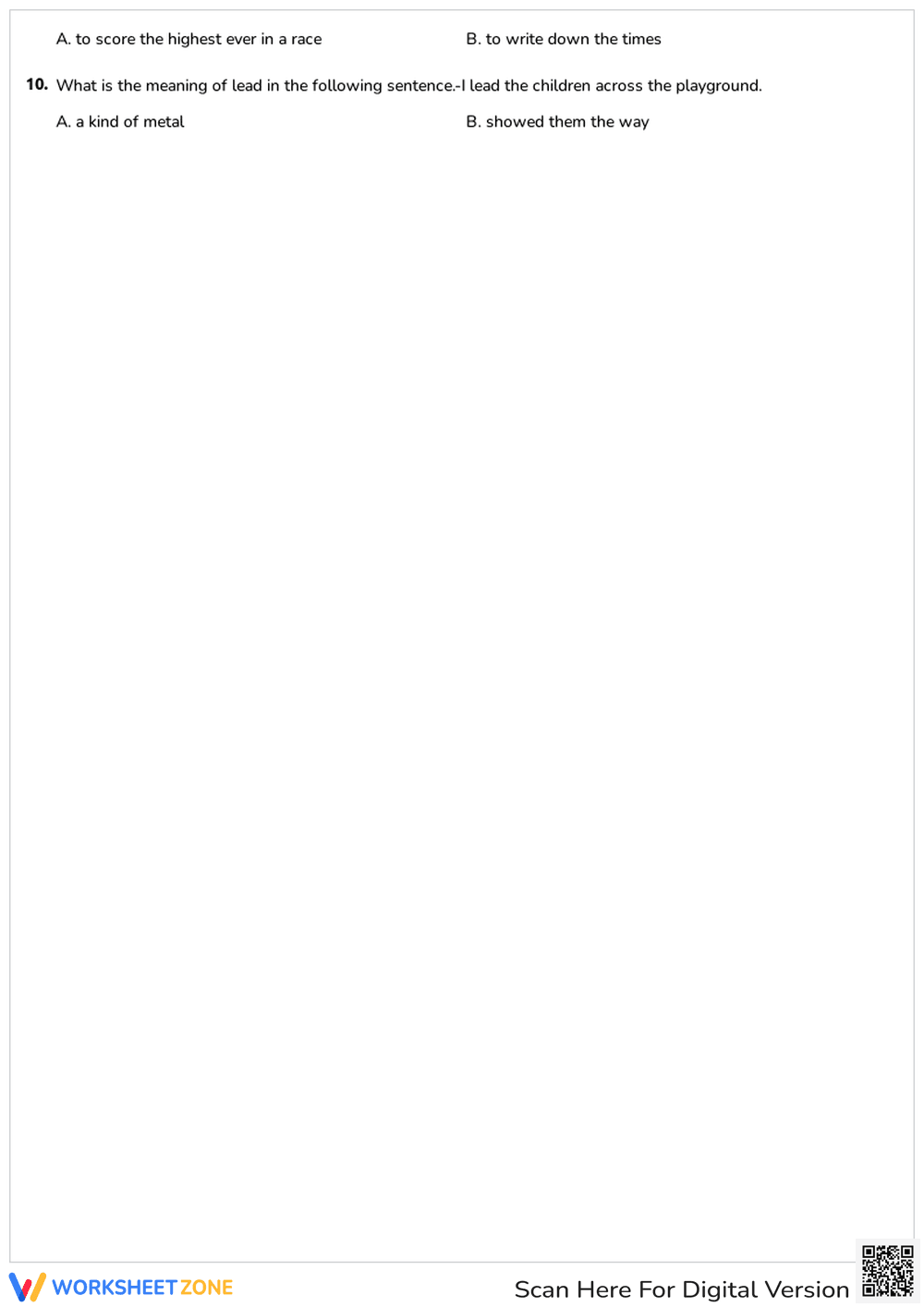
The resource contains a structured 10-question quiz across two pages. It features clear, high-contrast text and a visual aid for the first problem to support early readers. Students encounter common homographs such as "bank," "wind," "bass," and "lead." The format includes multiple-choice definitions and a true/false check on the distinction between homophones and homographs, ensuring a comprehensive check of vocabulary knowledge and conceptual understanding.
This worksheet is designed for a zero-prep classroom workflow. Teachers can print the two-page PDF in less than 30 seconds. Distribution takes approximately one minute, and because the questions are multiple-choice, the review process is exceptionally fast. Total teacher preparation time is under 2 minutes, making this an ideal resource for morning work, exit tickets, or emergency sub plans when instructional time is limited.
This activity is directly aligned to CCSS.ELA-LITERACY.L.2.4, which requires students to determine or clarify the meaning of unknown and multiple-meaning words and phrases. It specifically targets the ability to use sentence-level context as a clue to the meaning of a word. Both standard codes can be copied directly into lesson plans, IEP goals, or district curriculum mapping tools to ensure compliance with state frameworks.
Use this worksheet as a mid-unit formative assessment after introducing the concept of homographs. During the activity, observe if students are reading the entire sentence or just looking at the target word; this provides a valuable observation tip for identifying who needs more support with context clues. It typically takes 15 to 20 minutes for independent completion, fitting perfectly into a standard ELA block.
This resource is primarily for 2nd-grade students, though it serves as an excellent review for 3rd graders or a challenge for advanced 1st graders. It pairs naturally with a classroom anchor chart on multiple-meaning words or a direct instruction lesson on using a dictionary to find secondary definitions. It is particularly helpful for English Language Learners who are navigating the complexities of English vocabulary.
Vocabulary acquisition through the study of homographs is a cornerstone of literacy development. According to Fisher & Frey (2014), the ability to resolve ambiguity in multiple-meaning words is a significant predictor of overall reading comprehension. This worksheet addresses the L.2.4 standard by providing 10 targeted practice opportunities that require students to apply semantic logic to common English homographs. Research from the NAEP indicates that students who struggle with context-dependent definitions often face barriers in complex text analysis. By isolating these words in a structured, printable format, educators can provide the repeated exposure necessary for mastery. This resource ensures that the plain-English skill of using context clues is reinforced through high-frequency vocabulary, making it a reliable tool for both general education and targeted intervention settings.


