


























Views
Downloads

Essential Indefinite Articles Worksheet | Grade 1-4 ELA
Paste this activity's link or code into your existing LMS (Google Classroom, Canvas, Teams, Schoology, Moodle, etc.).
Students can open and work on the activity right away, with no student login required.
You'll still be able to track student progress and results from your teacher account.
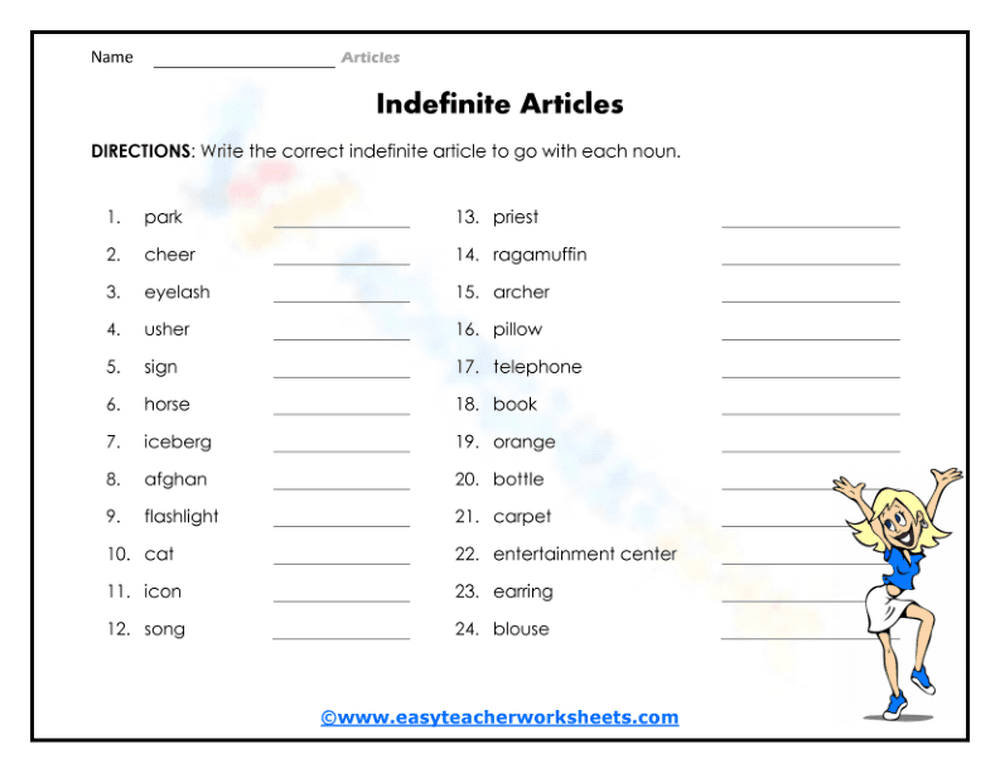
This "Indefinite Articles" grammar worksheet provides students with targeted practice in selecting the correct determiner for common nouns. By working through 24 distinct examples, learners master the rules governing "a" versus "an" based on vowel and consonant sounds. This foundational ELA resource ensures students build the syntactic accuracy required for fluent writing and speaking.
At a Glance
- Grade: 1–4 · Subject: Grammar
- Standard:
CCSS.ELA-LITERACY.L.1.1.H— Use determiners including articles correctly in sentences and phrases- Skill Focus: Indefinite Articles (A vs. An)
- Format: 1 page · 24 problems · Answer key included · PDF
- Best For: Grammar drills and morning work
- Time: 10–15 minutes
What's Inside
This single-page PDF contains 24 high-frequency nouns paired with clear response lines for student input. The task requires students to evaluate the initial sound of each word—ranging from simple consonants like "cat" to vowel-starting nouns like "iceberg"—and apply the correct indefinite article. A comprehensive answer key is included to facilitate rapid grading or self-correction.
Zero-Prep Workflow
This resource is designed for immediate classroom implementation with a total prep time of under two minutes. First, print the single-page master (30 seconds). Second, distribute to students for independent practice or a quick warm-up (30 seconds). Finally, review the 24 items using the included answer key for immediate formative feedback (60 seconds). It is an ideal solution for substitute folders or emergency lesson plans.
Standards Alignment
This worksheet is directly aligned to CCSS.ELA-LITERACY.L.1.1.H, which requires students to use determiners, specifically articles, with precision. Mastering the distinction between "a" and "an" is a critical milestone in early literacy that supports phonetic awareness and grammatical fluency. This standard code can be copied directly into lesson plans, IEP goals, or district curriculum mapping tools.
How to Use It
Assign this worksheet during the independent practice phase of a grammar lesson after introducing the "vowel sound" rule for "an." It also serves as an effective formative assessment tool; observe if students struggle with words like "usher" or "afghan" to identify needs for phonetic intervention. The worksheet typically takes 10 to 15 minutes to complete.
Who It's For
This resource is tailored for elementary students in Grades 1 through 4 who are developing or refining their understanding of English grammar conventions. It provides necessary scaffolding for English Language Learners (ELL) and students requiring additional support with determiner usage. Pair this with a vowel/consonant anchor chart for a complete instructional cycle.
According to the RAND AIRS 2024 report, high-quality supplemental materials that provide focused, repetitive practice are essential for cementing foundational grammatical skills like determiner usage. This worksheet targets the CCSS.ELA-LITERACY.L.1.1.H standard by providing 24 opportunities for students to differentiate between "a" and "an." Research by Fisher & Frey (2014) highlights that such targeted drills allow students to move from guided to independent mastery of complex syntax. By isolating the variable of article choice, this resource reduces cognitive load, enabling learners to focus entirely on the phonetic rules of indefinite articles. The inclusion of diverse nouns ensures that students encounter a wide array of phonemes, reinforcing the connection between oral sound and written structure. This evidence-based approach is a reliable tool for educators seeking to improve student performance in early writing and language mechanics.


