


























Views
Downloads

Essential Equivalent Ratio Worksheet | Grades 3-5 Math
Paste this activity's link or code into your existing LMS (Google Classroom, Canvas, Teams, Schoology, Moodle, etc.).
Students can open and work on the activity right away, with no student login required.
You'll still be able to track student progress and results from your teacher account.
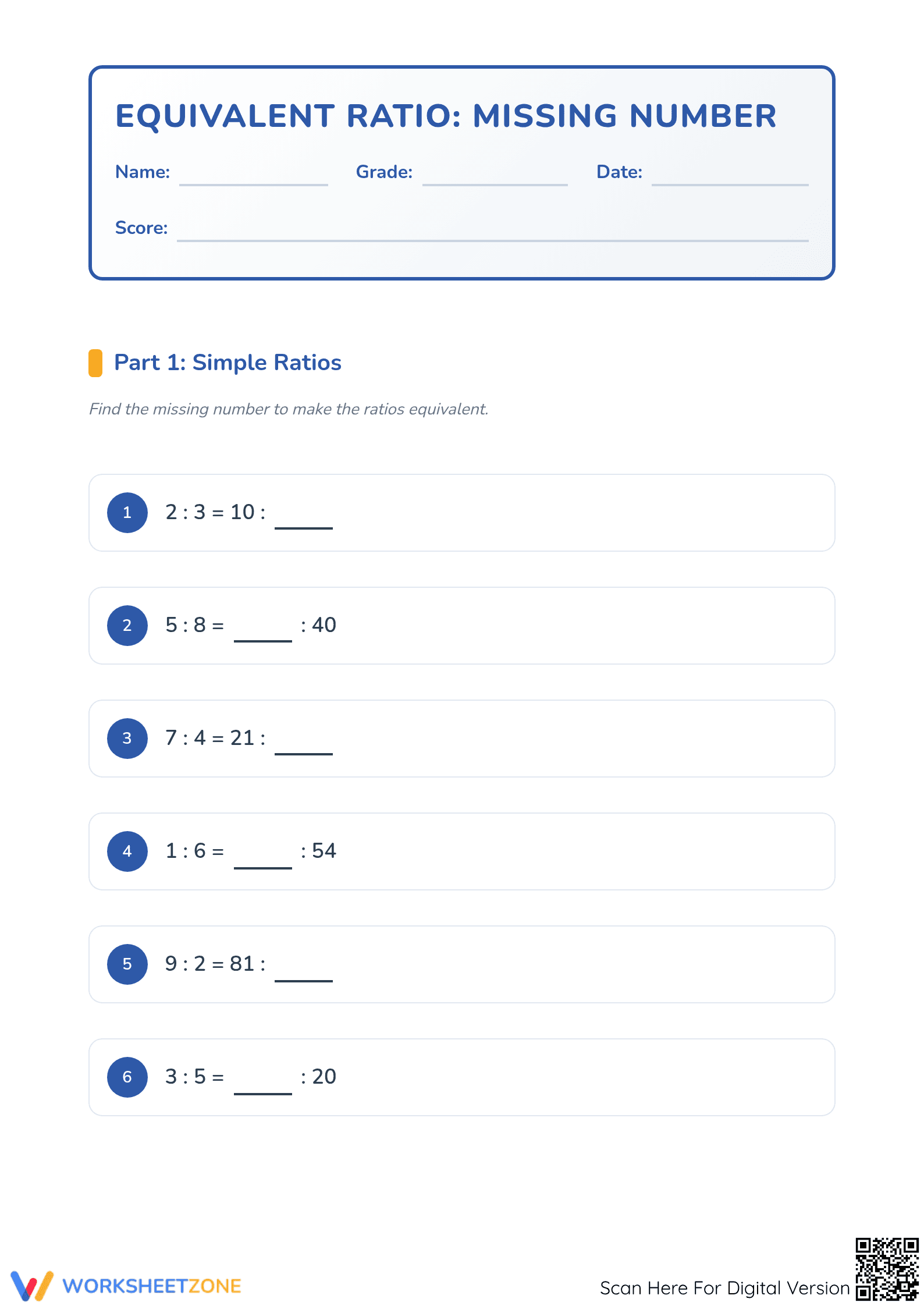
This equivalent ratio worksheet empowers upper elementary students to master proportions through a structured, multi-part practice set. By calculating missing numbers in ratios, completing tables, and solving word problems, learners develop the multiplicative reasoning necessary for algebraic success. This comprehensive resource ensures students can identify and generate equivalent values with confidence.
At a Glance
- Grade: 3–5 · Subject: Math
- Standard:
6.RP.A.3— Use ratio and rate reasoning to solve real-world and mathematical problems- Skill Focus: Equivalent Ratios and Proportions
- Format: 5 pages · 32 problems · Answer key included · PDF
- Best For: Independent practice and homework reinforcement
- Time: 30–45 minutes
What's Inside
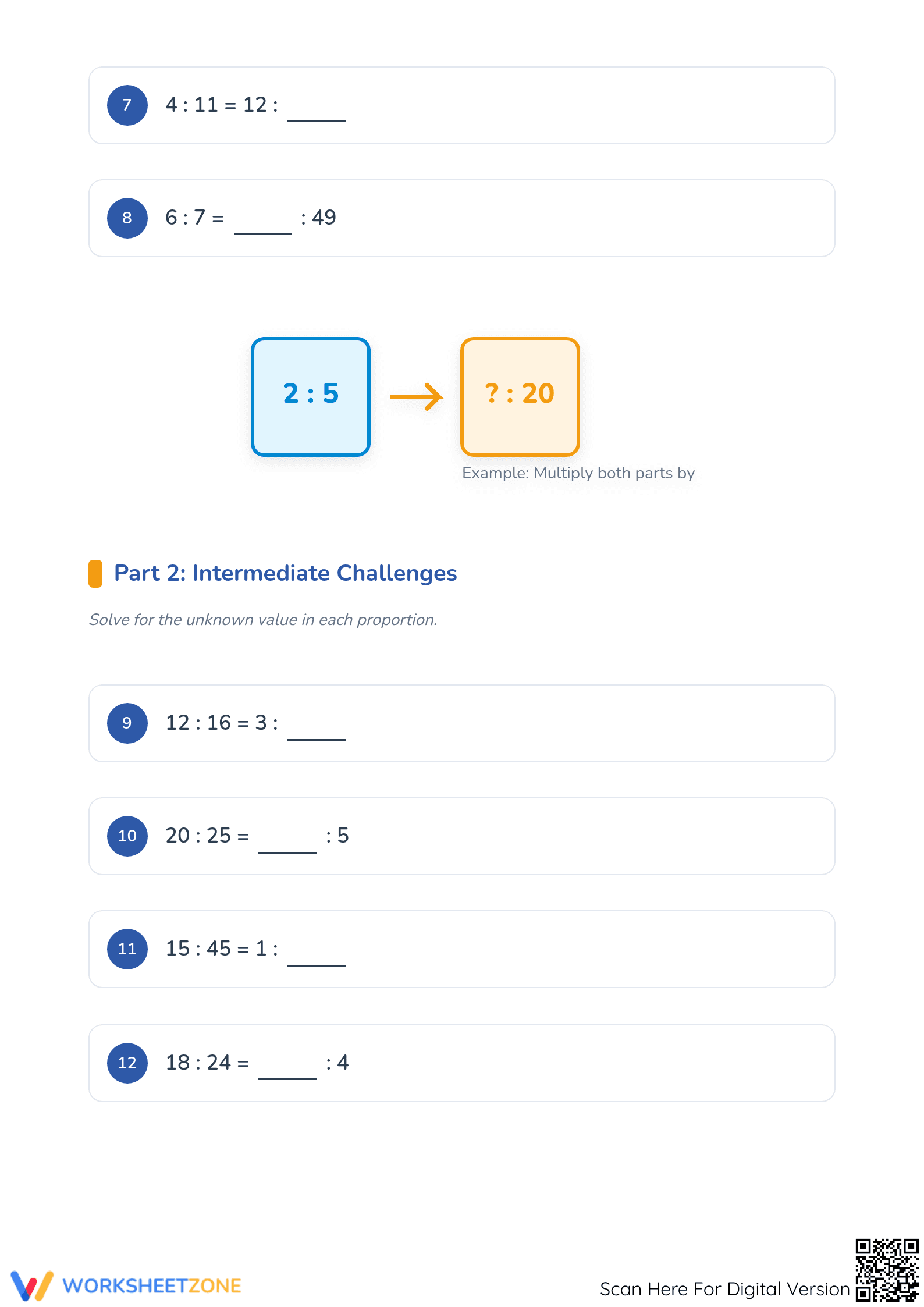
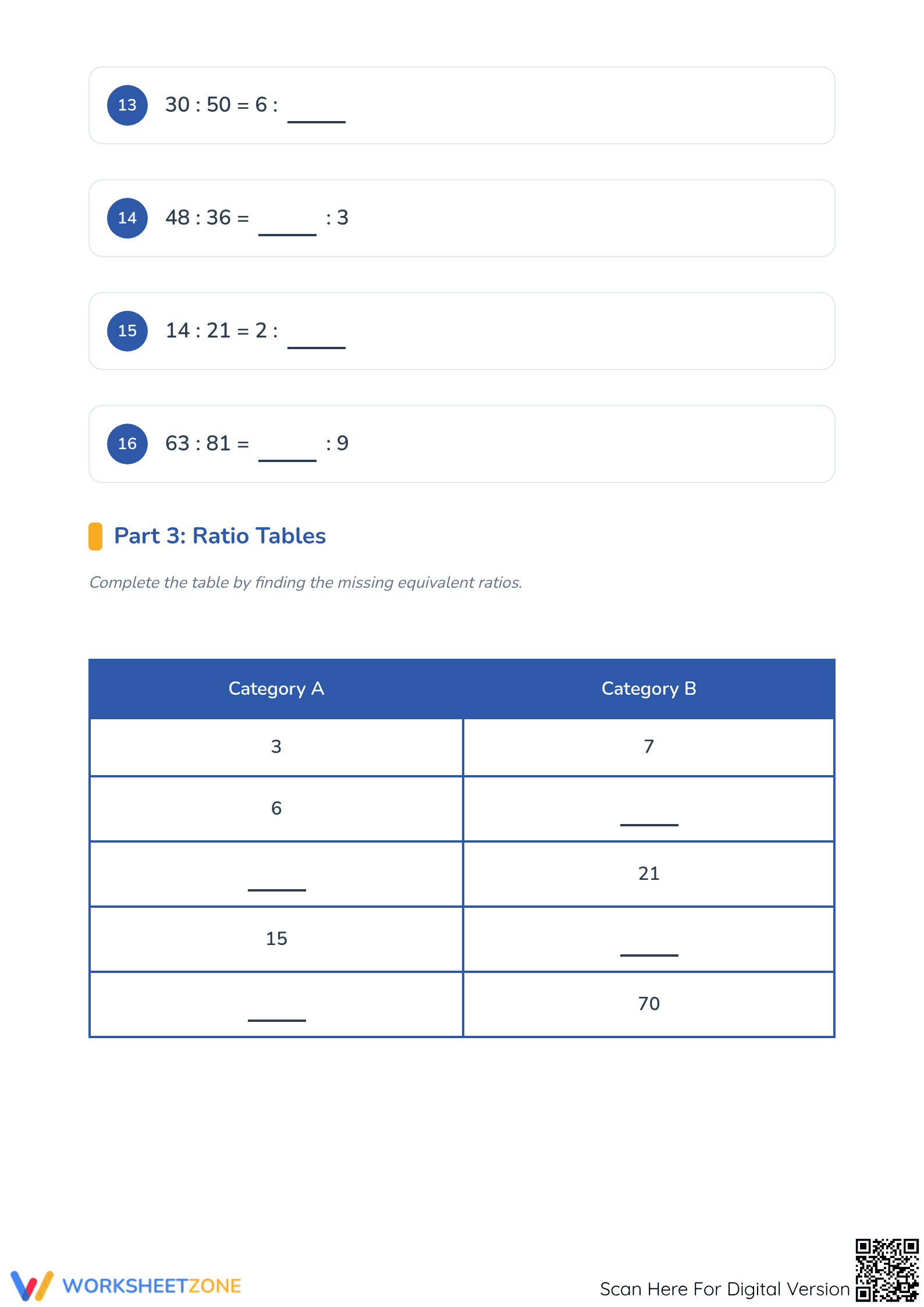
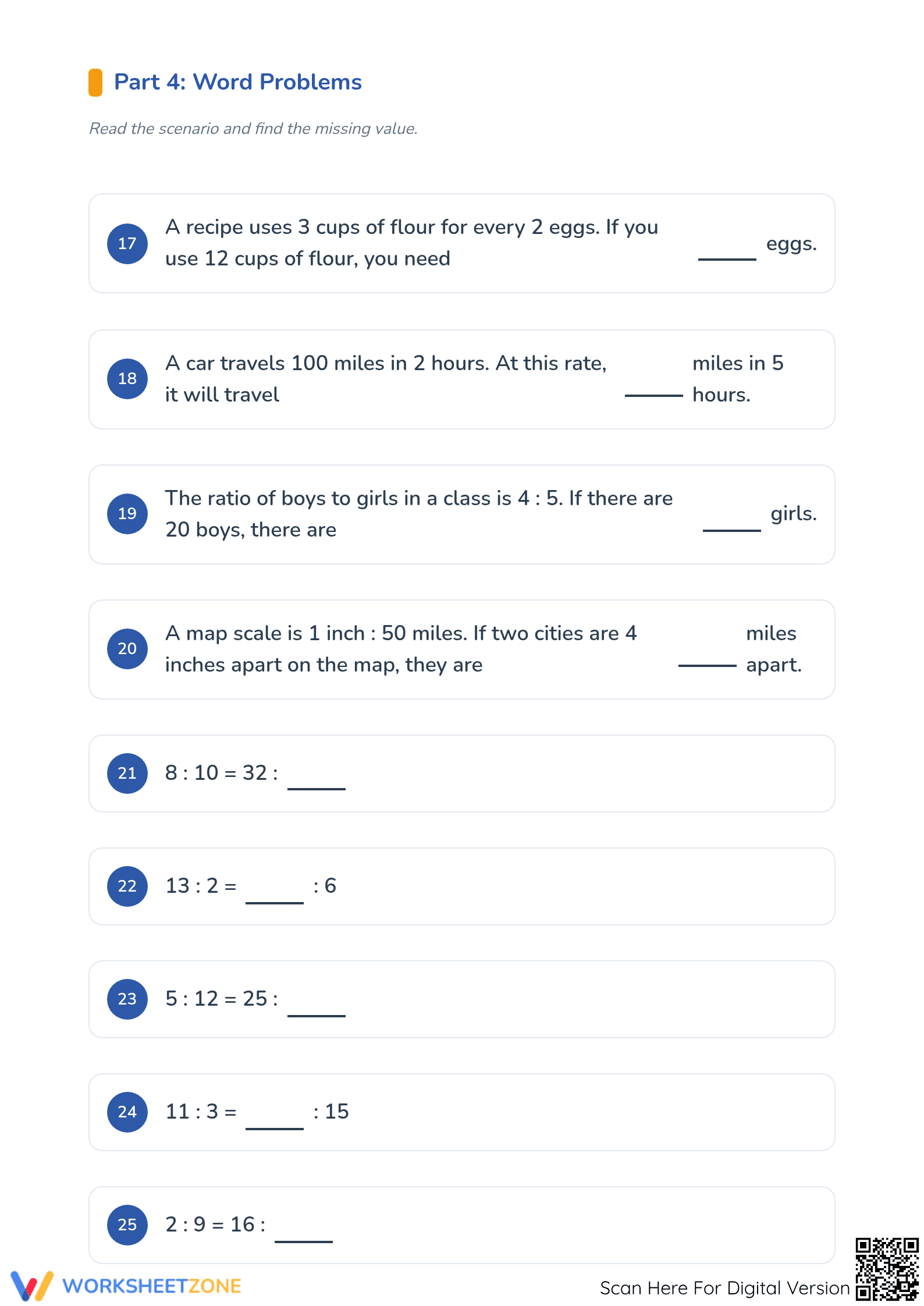
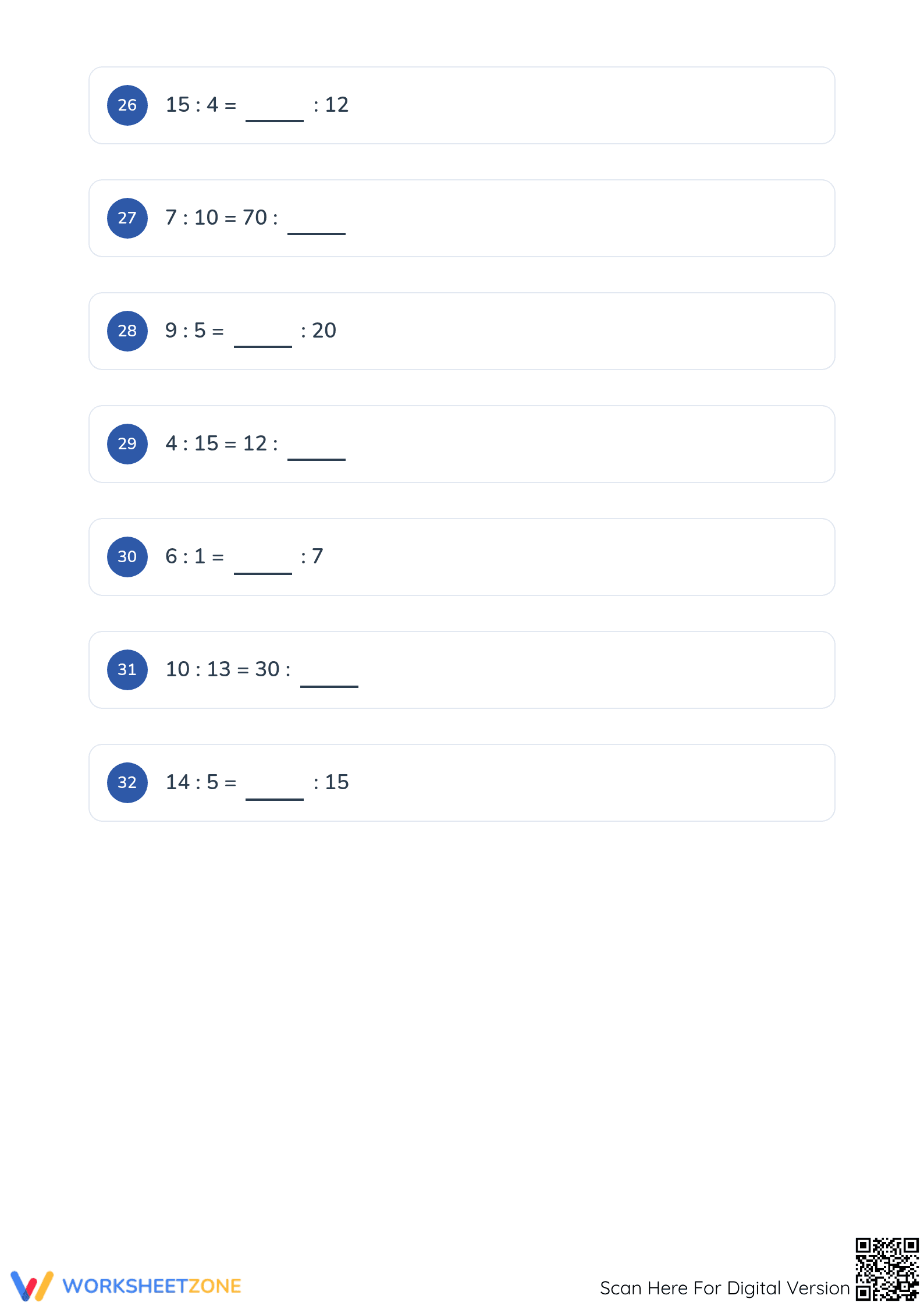
This five-page PDF collection features 32 distinct tasks designed to build fluency with ratios. The worksheet is organized into four logical parts: simple ratio completion, intermediate proportion challenges, ratio tables for categorical comparisons, and contextual word problems. A worked example on the second page provides a visual model for multiplicative scaling, and a full answer key is provided for immediate grading.
Skill Progression
- Guided Practice: The first eight tasks focus on basic equivalent ratios, allowing students to identify scale factors with simple whole-number multipliers.
- Supported Practice: Problems 9 through 16 and the ratio table introduce intermediate challenges where students must apply inverse operations to maintain proportionality.
- Independent Practice: The final sixteen tasks include word problems involving map scales and recipes, requiring students to solve for missing variables without scaffolds.
This sequence utilizes a gradual-release model, transitioning students from procedural computation to abstract application of ratio reasoning.
Standards Alignment
6.RP.A.3 - Use ratio and rate reasoning to solve real-world and mathematical problems, e.g., by reasoning about tables of equivalent ratios, tape diagrams, double number line diagrams, or equations. While identified for Grades 3-5 in local curriculum maps, this content specifically prepares students for Middle School Ratios and Proportional Relationships. Both standard codes can be copied directly into lesson plans, IEP goals, or district curriculum mapping tools.
How to Use It
Assign this worksheet during the "You Do" phase of a lesson on introduction to ratios. Observe students working on the word problems to see if they can correctly set up the initial proportion before solving. Expected completion time ranges from 30 to 45 minutes.
Who It's For
This resource is ideal for Grade 4 and 5 students who are transitioning from basic multiplication to proportional reasoning. It also serves as an excellent intervention tool for Grade 6 students who need a refresher on finding missing values in simple proportions. Pair this with a physical anchor chart showing scaling techniques for maximum impact.
Research by Fisher & Frey (2014) emphasizes that the gradual release of responsibility is essential when students encounter abstract mathematical concepts like equivalent ratios. This worksheet implements that framework by transitioning from simple 1:n ratios to complex, multi-step word problems involving rates and scales. By requiring students to complete ratio tables, the resource aligns with cognitive load theory, providing a structured workspace that minimizes extraneous processing while focusing on the core skill of multiplicative comparison. According to the NAEP framework, the ability to solve for a missing value in a proportion—as defined in 6.RP.A.3—is a high-utility skill that correlates strongly with later success in coordinate geometry and linear functions. This Grade 3-5 practice set provides the 32 necessary repetitions to move from procedural knowledge to conceptual mastery, ensuring that learners can apply ratio reasoning across diverse mathematical domains. This focused repetition builds the neural pathways required for fluency in higher-level algebraic operations.


