


























Views
Downloads
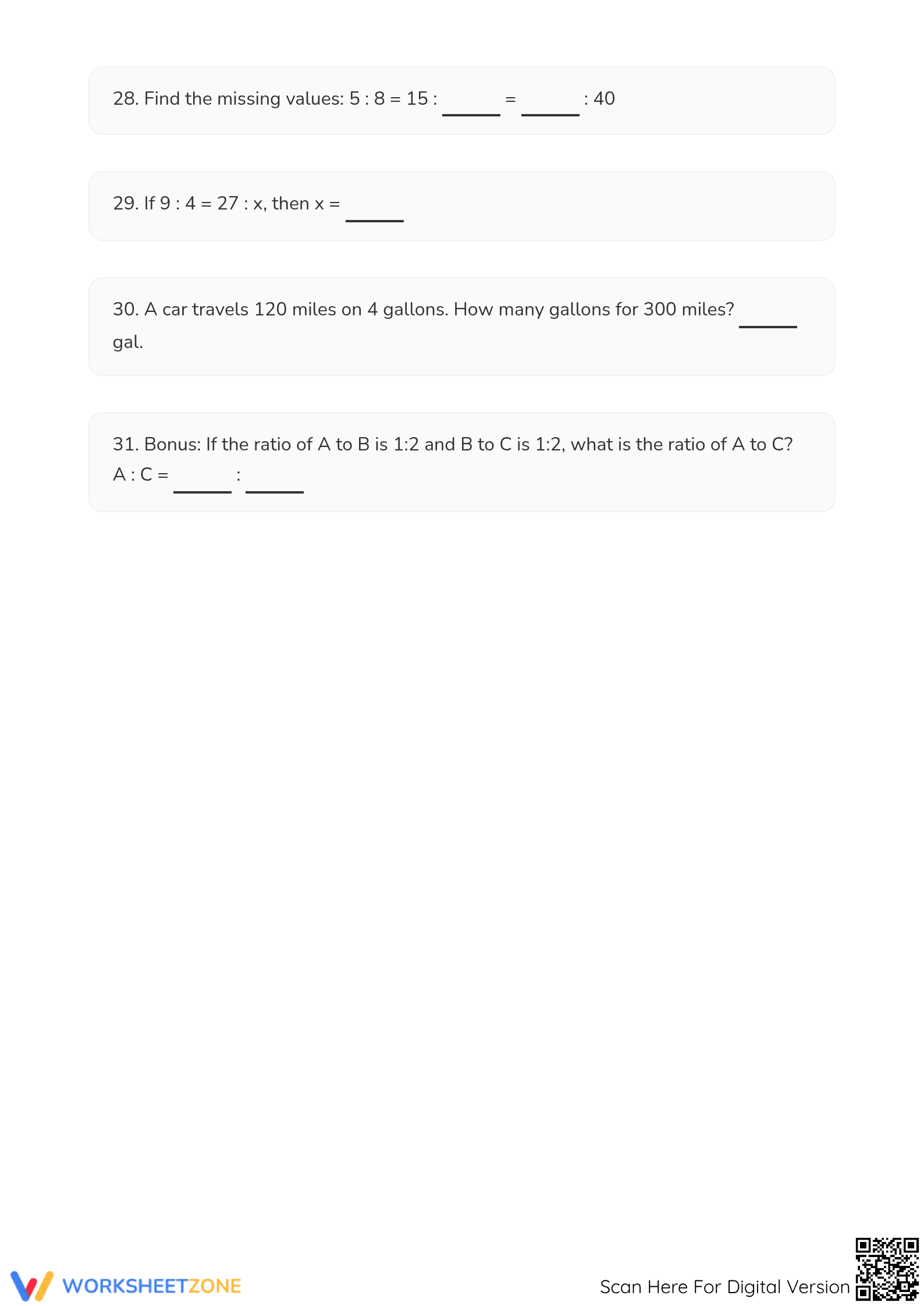

Essential Equivalent Ratios Worksheet | Grade 5 Math
Paste this activity's link or code into your existing LMS (Google Classroom, Canvas, Teams, Schoology, Moodle, etc.).
Students can open and work on the activity right away, with no student login required.
You'll still be able to track student progress and results from your teacher account.
Strengthen students' proportional reasoning with this comprehensive equivalent ratios worksheet for Grade 5 learners. This resource helps students identify and calculate missing values in ratios through 31 structured problems, progressing from basic computation to real-world application. Students will master maintaining constant relationships between numerical values in various contexts.
At a Glance
- Grade: 5 · Subject: Math
- Standard:
6.RP.A.3— Use ratio and rate reasoning to solve real-world and mathematical problems- Skill Focus: Calculating equivalent ratios and missing terms
- Format: 5 pages · 31 problems · Answer key included · PDF
- Best For: Independent practice or small group instruction
- Time: 30–45 minutes
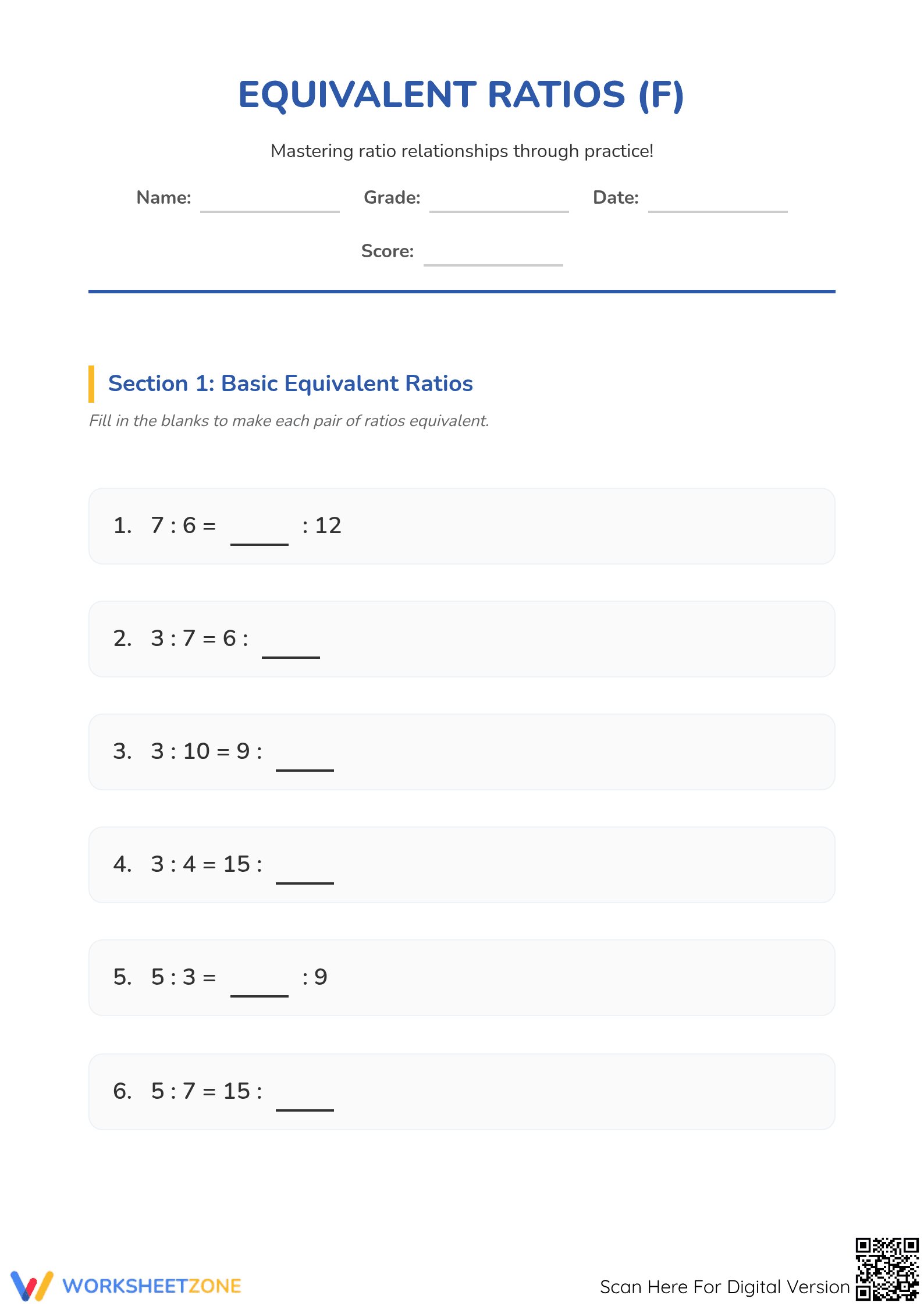
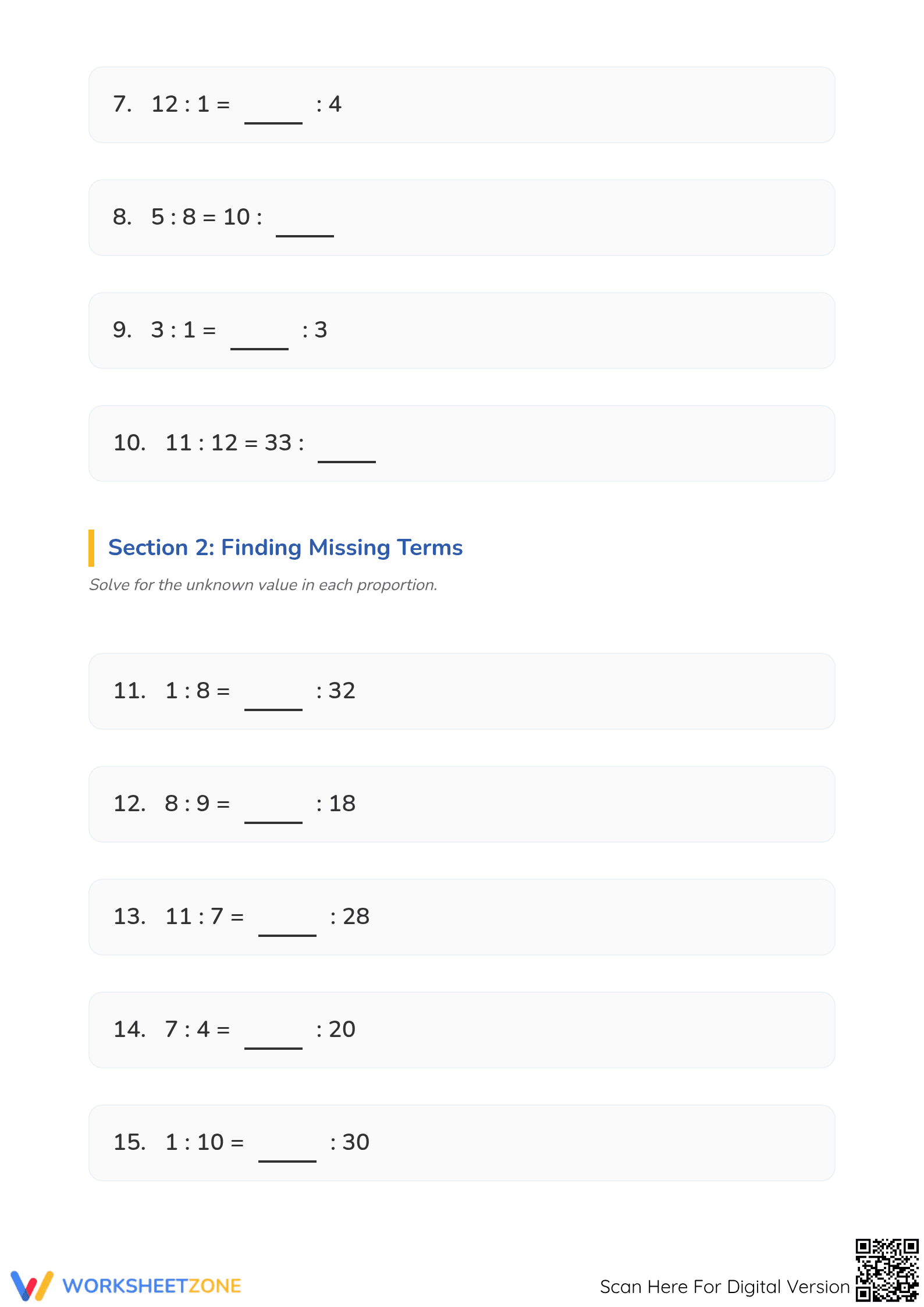
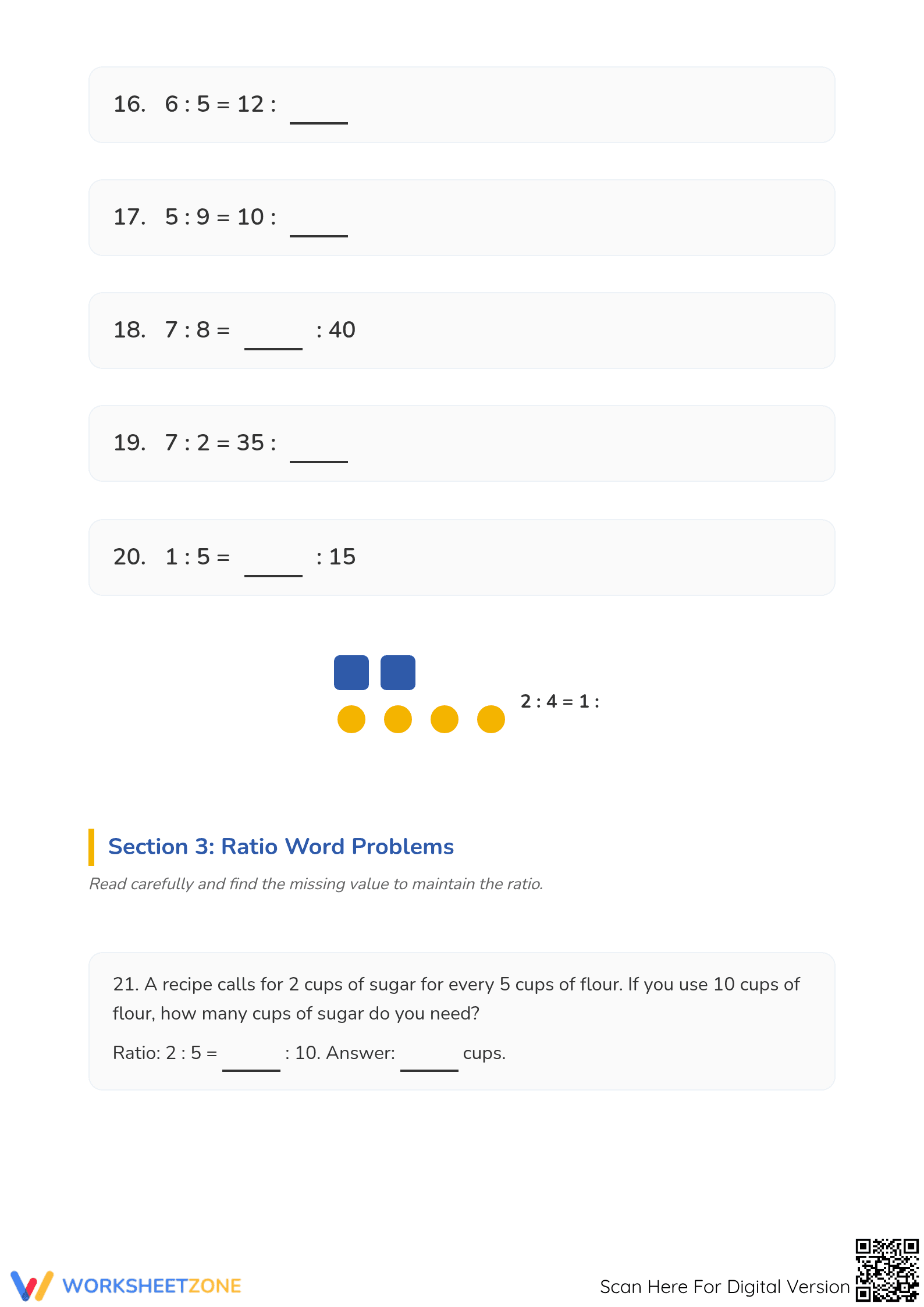
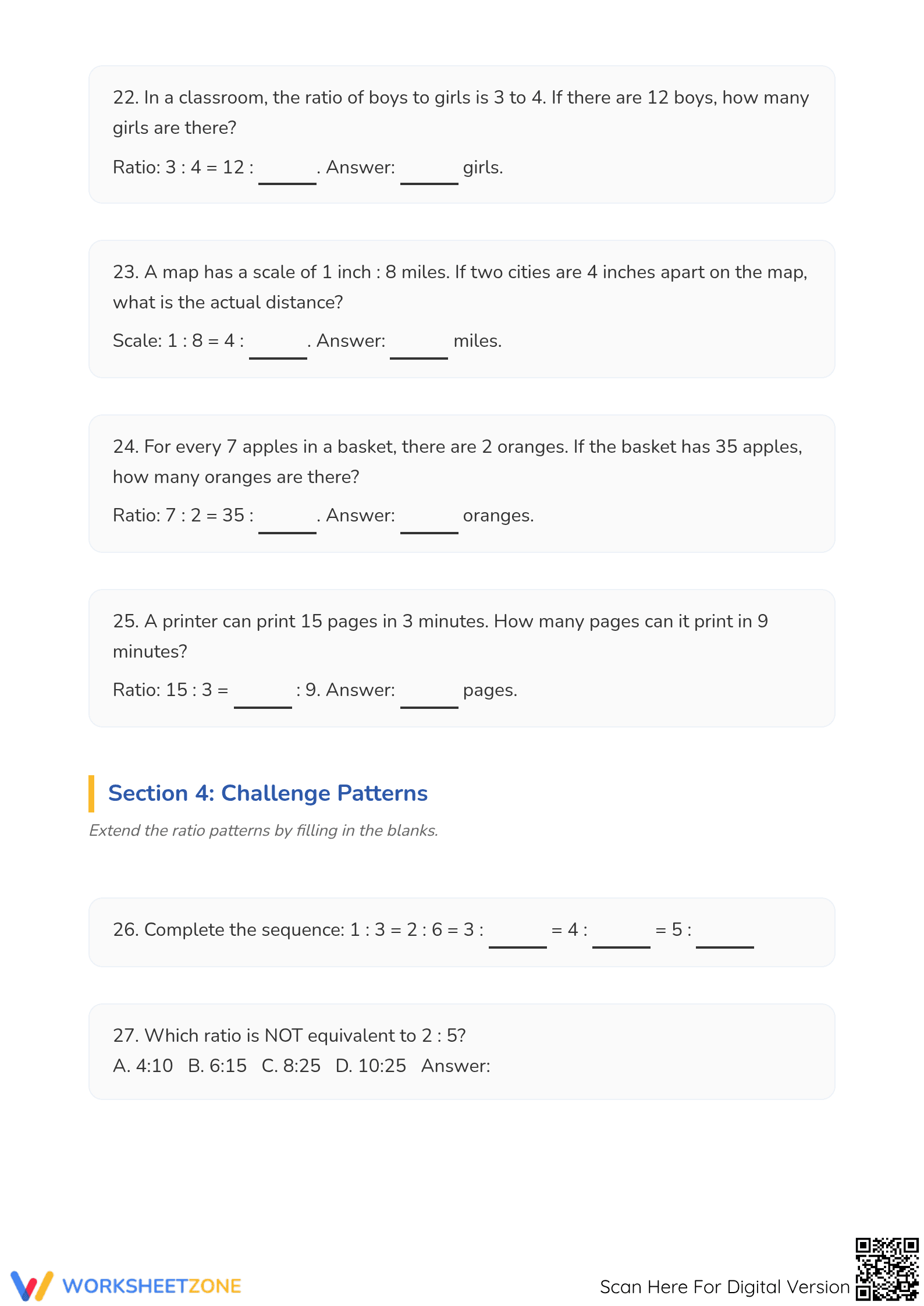
This 5-page PDF offers a rigorous collection of 31 ratio exercises across four sections: 10 basic equivalent ratio problems, 10 intermediate missing-term proportions, 5 real-world word problems (recipes, scales), and 6 challenge pattern sequences. A full answer key supports rapid grading and student feedback.
Skill Progression
- Guided Practice: First section: 10 scaffolded problems filling in missing numbers in basic 1:1 ratio equations; builds confidence with multiplication and division.
- Supported Practice: Sections two and three: 15 problems setting up proportions, applying cross-multiplication or scaling factors to solve for unknowns in abstract and contextual settings.
- Independent Practice: Final challenge section: 6 higher-order tasks; extend complex numerical patterns and identify non-equivalent ratios from multiple-choice options.
This gradual-release sequence progresses from simple recall to ratio relationship synthesis.
Standards Alignment
Aligned with CCSS.MATH.CONTENT.6.RP.A.3, this worksheet focuses on ratio and rate reasoning to solve real-world problems, using tables of equivalent ratios. For Grade 5, it builds foundational proportional reasoning for middle school. The standard code is suitable for lesson plans, IEP goals, or curriculum mapping.
How to Use It
Ideal for the 'You Do' phase of lessons on equivalent fractions or introductory ratios. For formative assessment, observe student approach to Section 3 word problems; those struggling with 'part' vs. 'whole' may need tape diagram scaffolding. Completion time for all 31 tasks: approximately 40 minutes.
Who It's For
Tailored for general education 5th-graders or 6th-graders needing proportional thinking support. It pairs well with introductory fraction lessons or direct instruction on scale factors. Its clear, predictable structure also benefits English Language Learners needing repetitive mathematical syntax.
Focusing on CCSS.MATH.CONTENT.6.RP.A.3, this resource trains students in ratio and rate reasoning to solve real-world problems via equivalent ratios. Calculating missing terms and extending patterns helps learners grasp multiplicative relationships. Research (Fisher & Frey, 2014) shows gradual release models—computation to complex word problems—are vital for fluency. This worksheet's tiered practice aligns with NAEP proportional reasoning framework, bridging simple multiplication to abstract algebraic thinking. Its 31 distinct tasks, from fill-in-the-blank ratios to multi-step recipe and map scale problems, offer high-repetition practice for retention. EdReports (2024) confirms such targeted practice indicates success in middle-school math curricula.


