


























Views
Downloads


Printable Equivalent Ratios Worksheet | Grade 6 Math
Paste this activity's link or code into your existing LMS (Google Classroom, Canvas, Teams, Schoology, Moodle, etc.).
Students can open and work on the activity right away, with no student login required.
You'll still be able to track student progress and results from your teacher account.
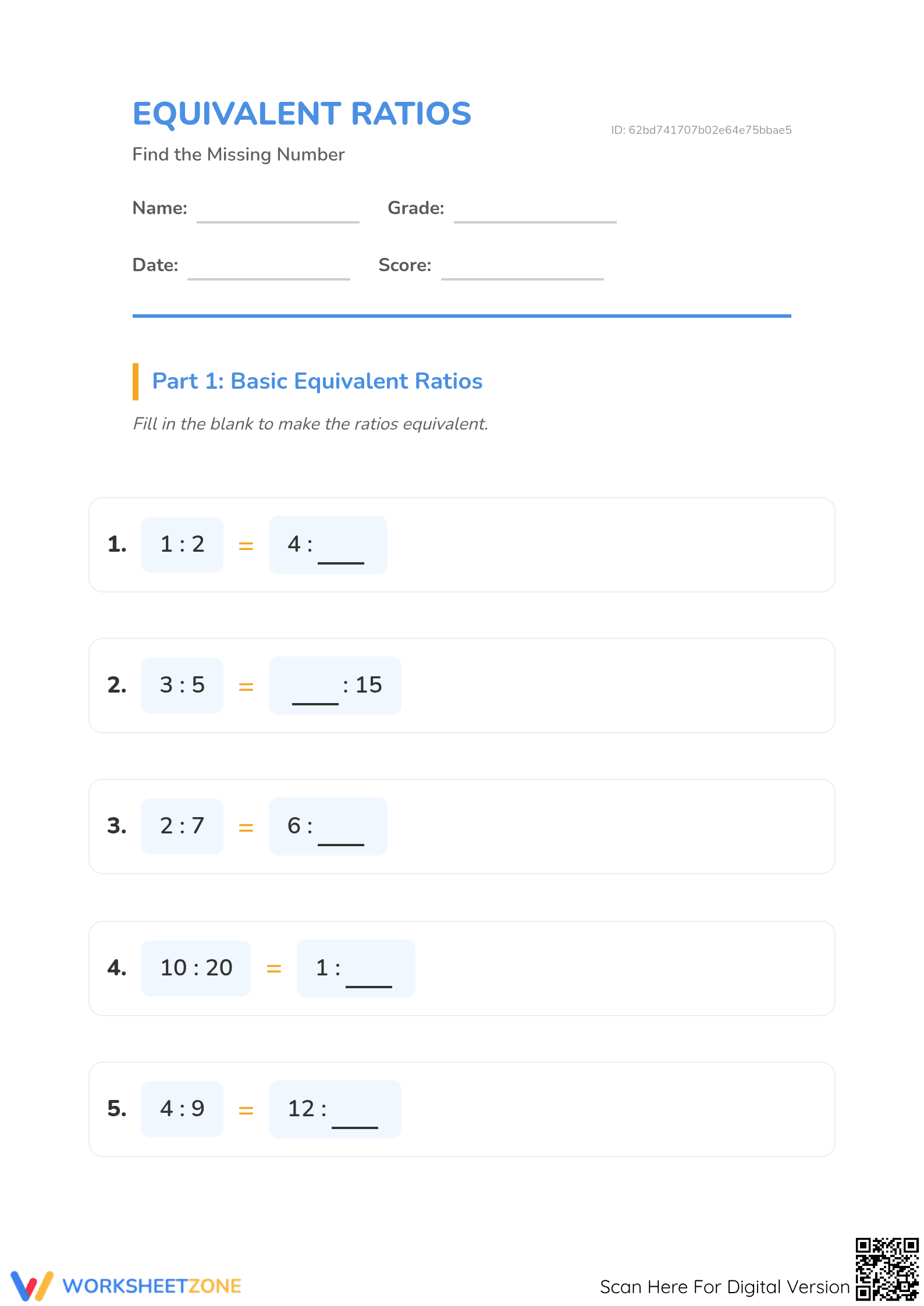
Master the concept of equivalent ratios with this comprehensive 5-page practice packet. Students learn to identify and calculate missing values in ratios using various formats, including basic equations, extended chains, structured tables, and real-world word problems to ensure deep mathematical understanding and proportional reasoning mastery.
At a Glance
- Grade: 6 · Subject: Math
- Standard:
6.RP.A.3— Use ratio and rate reasoning to solve real-world and mathematical problems- Skill Focus: Calculating equivalent ratios and missing values
- Format: 5 pages · 18 problems · Answer key included · PDF
- Best For: Independent practice, homework, or formative assessment
- Time: 40–50 minutes
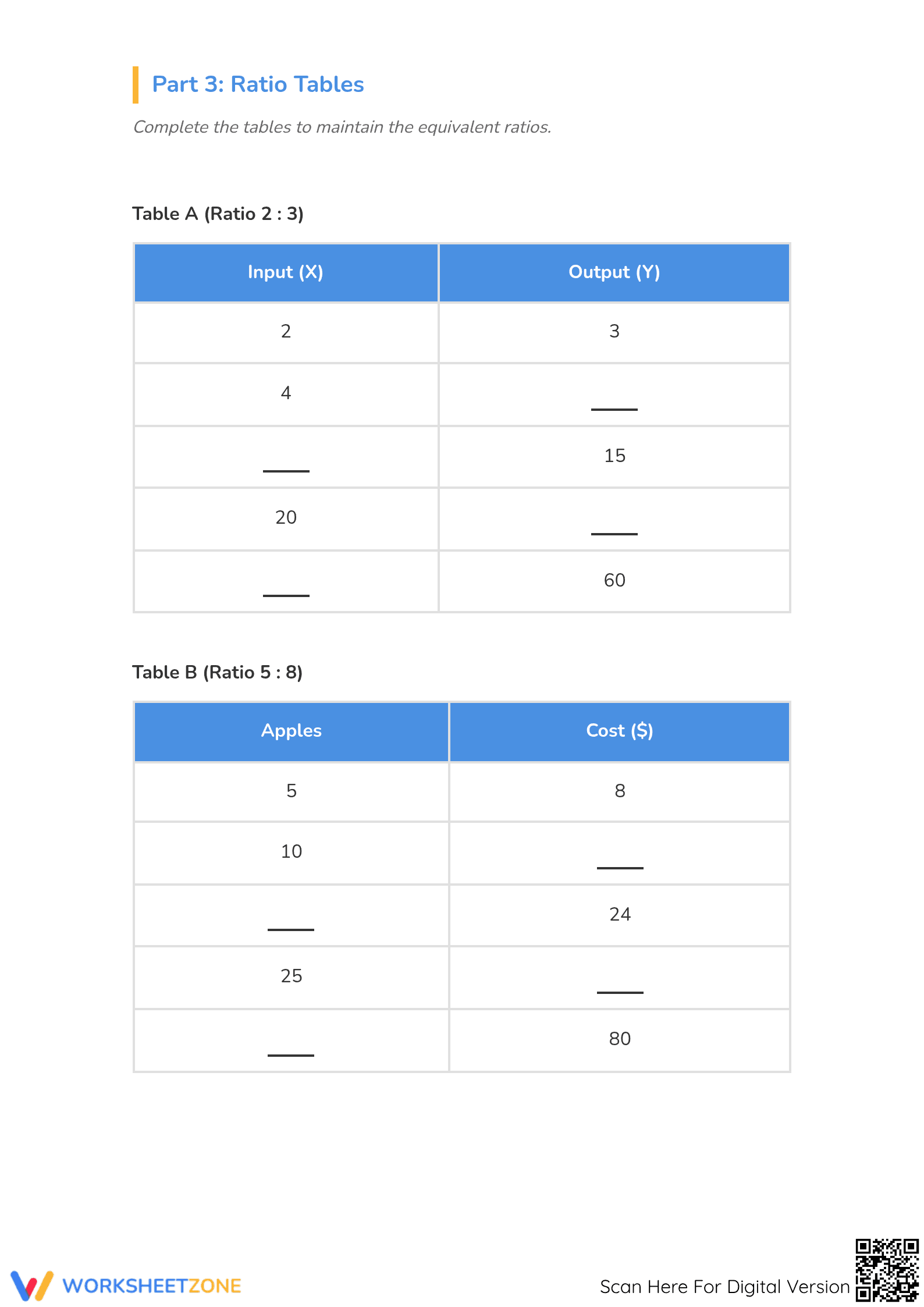
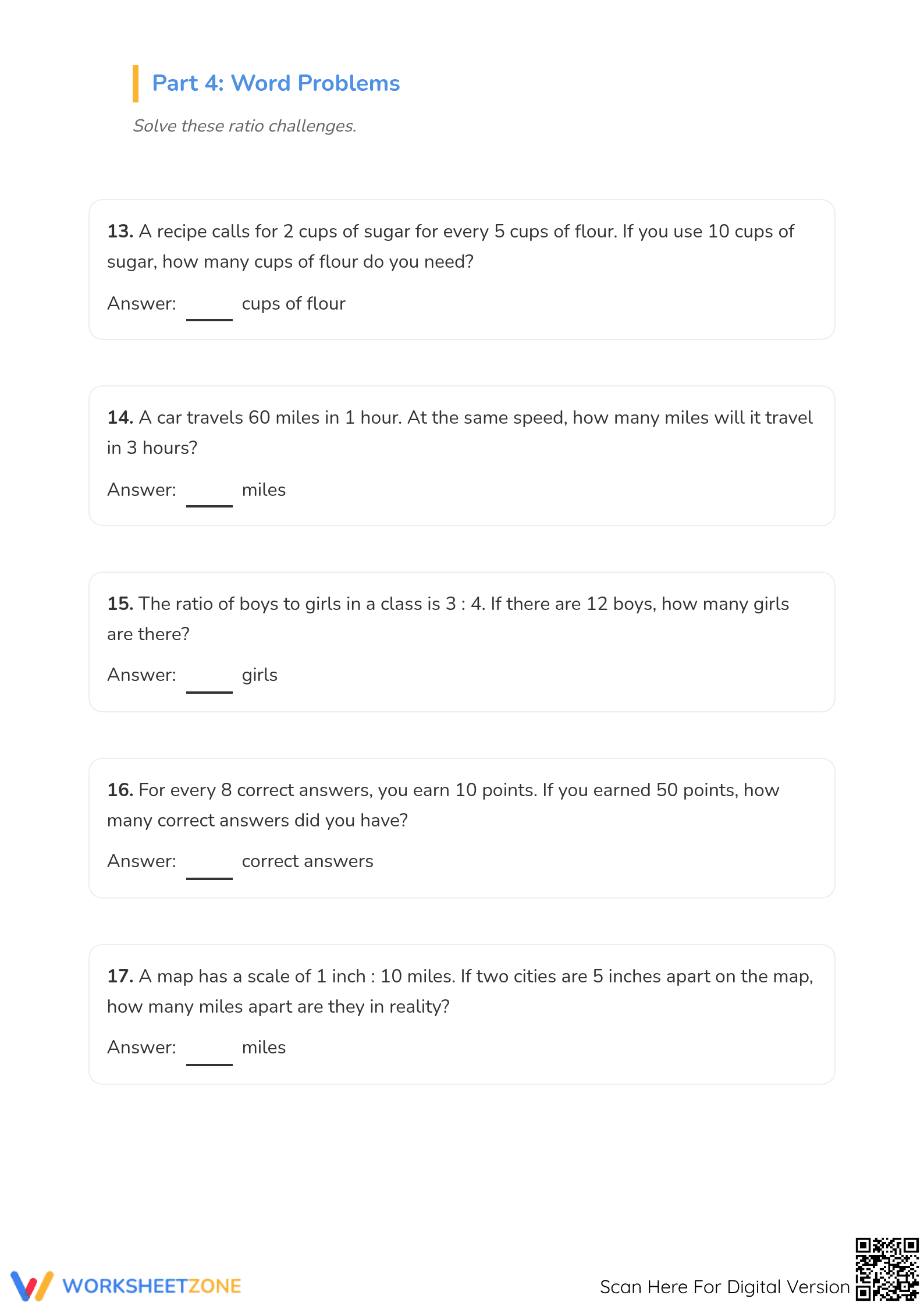
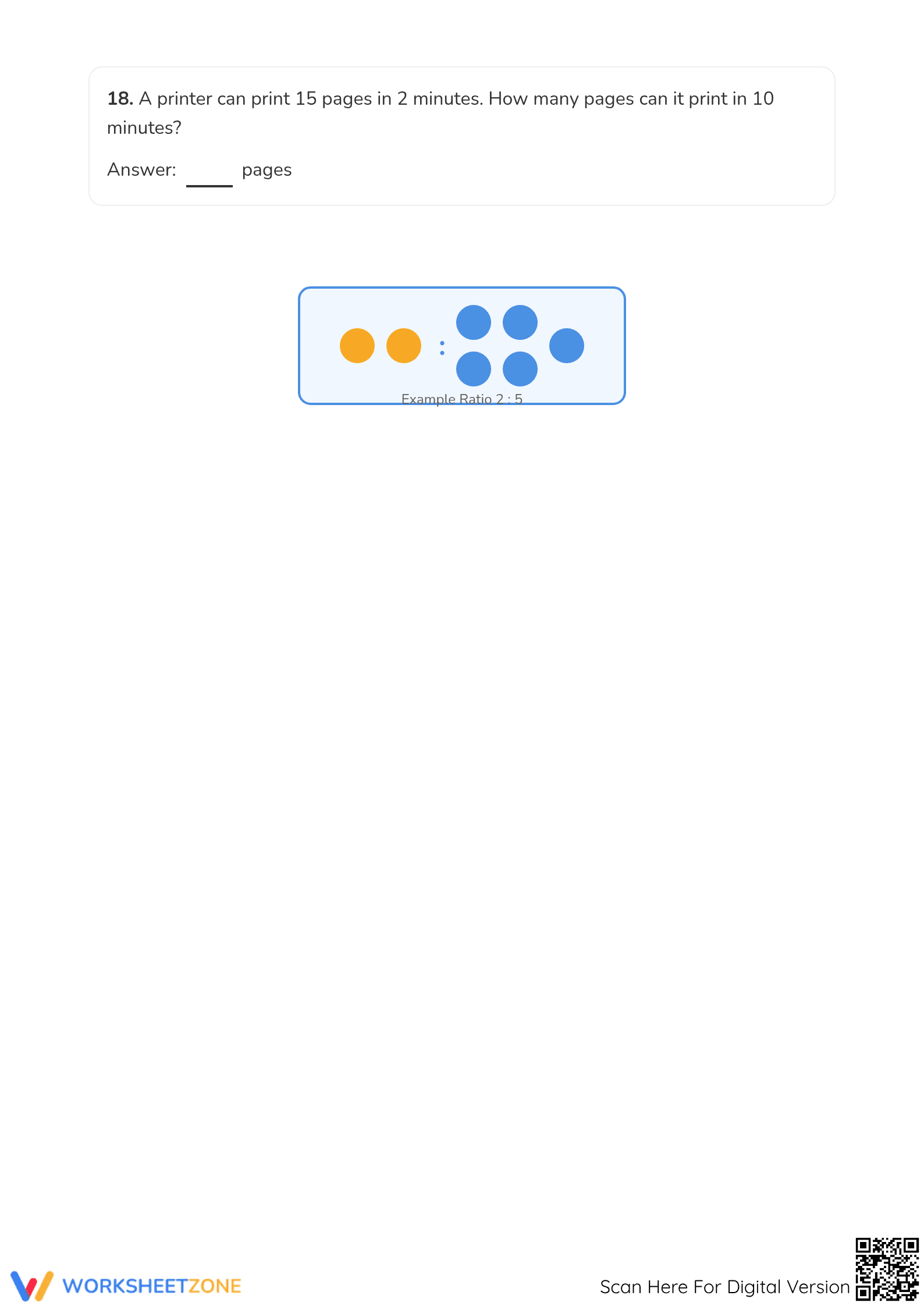
This 5-page PDF contains 18 diverse mathematical tasks. It includes basic missing-number equations, multiple-ratio chains for proportional reasoning, two structured ratio tables involving input/output and cost, and six rigorous word problems. A full answer key is provided for quick grading and student self-correction.
Skill Progression
- Guided practice: The first section features 8 basic equations where students find a single missing value, establishing the fundamental logic of scaling within ratios.
- Supported practice: Section two and three introduce ratio chains and tables, requiring students to maintain proportional relationships across multiple data points.
- Independent practice: The final section presents 6 word problems, challenging students to apply their knowledge to scenarios like recipes, travel, and map scales.
This gradual release model moves students from simple computation to high-level application using the I Do, We Do, You Do approach.
Standards Alignment
This resource is aligned to `6.RP.A.3`, which requires students to use ratio and rate reasoning to solve real-world and mathematical problems, such as by reasoning about tables of equivalent ratios or equations. This standard code can be copied directly into lesson plans, IEP goals, or district curriculum mapping tools.
How to Use It
Use this as a main instructional activity during a unit on proportional relationships. After a mini-lesson on cross-multiplication or scaling, assign the first two pages for classwork. For a formative assessment tip, observe students as they tackle the word problems to identify if they can correctly set up the initial ratio before solving. Expected completion time is 45 minutes.
Who It's For
Designed for Grade 6 students mastering ratios, it also serves as an excellent enrichment tool for Grade 5 or a remedial review for Grade 7. The visual support and varied formats accommodate diverse learners. It pairs naturally with a ratio anchor chart or a hands-on kitchen mixing activity.
According to the RAND AIRS 2024 report, providing students with multiple representations of mathematical concepts, such as the tables and word problems found in this 6.RP.A.3 resource, significantly improves long-term retention of proportional reasoning. This worksheet focuses on the essential skill of finding missing values in equivalent ratios, a foundational pillar for future algebraic success. By moving from simple scaling tasks to complex real-world scenarios involving recipes and map distances, students build a robust mental model of how quantities relate to one another. The inclusion of 18 diverse problems ensures that learners encounter the concept in various contexts, which research from EdReports 2024 identifies as a key factor in high-quality instructional materials. This systematic approach allows teachers to identify specific misconceptions early, providing the targeted intervention necessary for mastery of ratios and proportional relationships in middle school mathematics.


