


























Views
Plays


Grade 5-6 Grammar & Vocabulary | Essential Worksheet
Paste this activity's link or code into your existing LMS (Google Classroom, Canvas, Teams, Schoology, Moodle, etc.).
Students can open and work on the activity right away, with no student login required.
You'll still be able to track student progress and results from your teacher account.
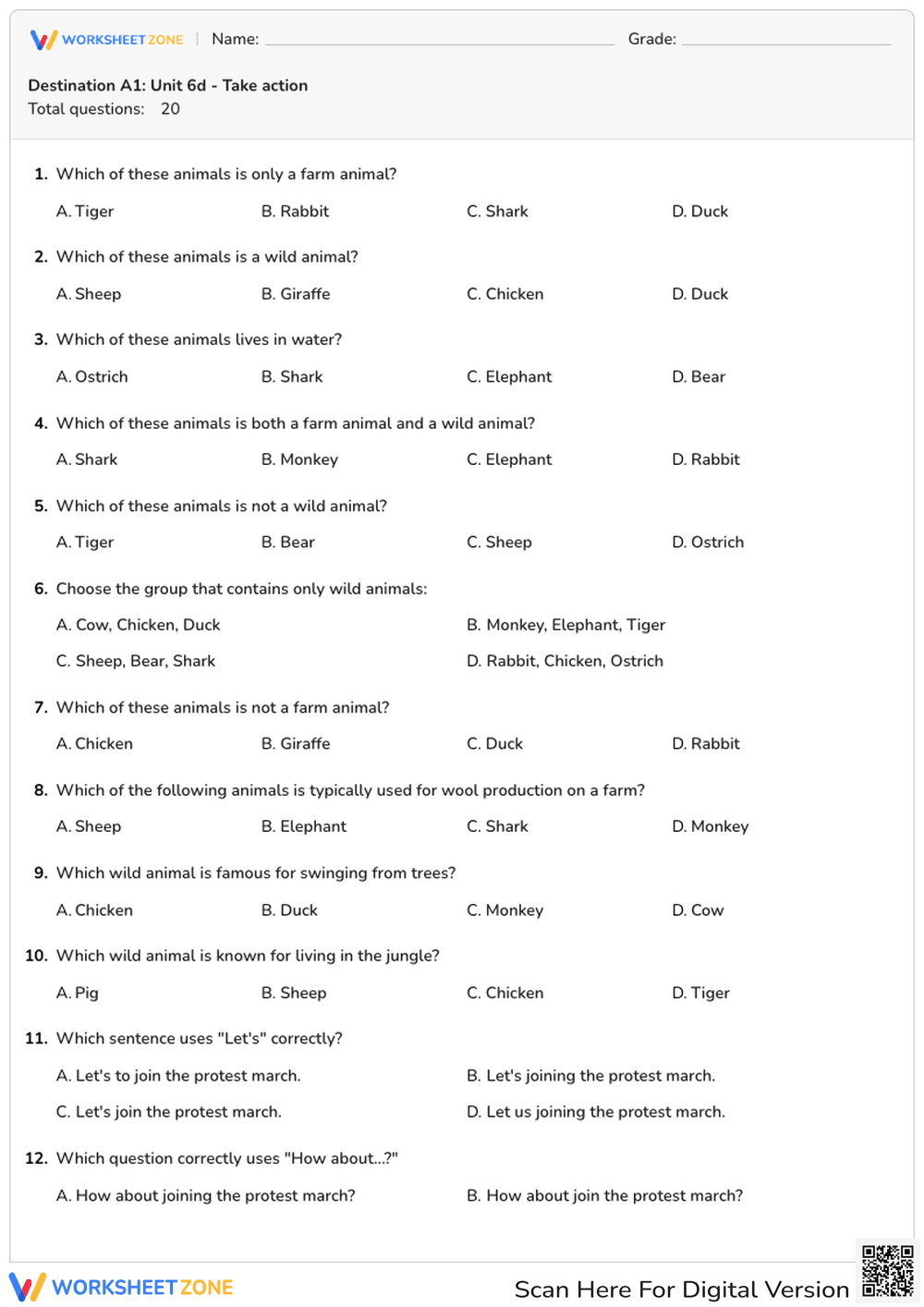
This Grade 5 and 6 ELA worksheet provides targeted practice in animal vocabulary classification and the grammatical structures used to make suggestions. Students demonstrate mastery by identifying farm versus wild animals and selecting the correct syntax for phrases like "Let's" and "How about." This resource ensures learners can accurately categorize information and apply standard English conventions in functional contexts.
At a Glance
- Grade: 5-6 · Subject: ELA Grammar
- Standard:
CCSS.ELA-LITERACY.L.5.1— Demonstrate command of the conventions of standard English grammar and usage- Skill Focus: Animal classification and making suggestions
- Format: 2 pages · 20 problems · Answer key included · PDF
- Best For: Quick grammar checks and vocabulary review
- Time: 15–20 minutes
What's Inside
The worksheet consists of 20 multiple-choice questions spread across two clearly organized pages. The first ten questions focus on vocabulary, requiring students to differentiate between animal types, habitats, and uses (such as wool production). The final ten questions transition into grammar, testing the correct application of suggestion-based sentence starters. The clear layout and consistent question format help students focus on the content without being overwhelmed by complex instructions.
Zero-Prep Workflow
- Print: Generate copies of the two-page PDF for your entire class in under 2 minutes.
- Distribute: Hand out as a bell-ringer or warm-up activity; students typically finish in 15 minutes.
- Review: Use the included answer key for immediate whole-group feedback on grammar rules.
Standards Alignment
The primary focus is `CCSS.ELA-LITERACY.L.5.1`, which requires students to demonstrate command of the conventions of standard English grammar and usage when writing or speaking. Specifically, it addresses the use of verb tenses and phrases that convey suggestions. Additionally, it supports vocabulary acquisition through the categorization of biological terms. Both standard codes can be copied directly into lesson plans, IEP goals, or district curriculum mapping tools.
How to Use It
Use this worksheet as a formative assessment after a lesson on making suggestions or as a vocabulary review during a unit on the natural world. It is particularly effective during the independent practice phase of a lesson. Teachers should observe if students struggle with the gerund form after "How about" (e.g., "How about joining") versus the base verb after "Why don't we." Expected completion time is approximately 15 to 20 minutes.
Who It's For
This resource is designed for Grade 5 and 6 students, but it is also highly effective for ESL/ELL learners working on A1-level English proficiency. It pairs naturally with an anchor chart detailing suggestion structures or a reading passage about wildlife conservation. The multiple-choice format provides necessary scaffolding for students who are still developing their writing confidence.
This Grade 5 and 6 ELA resource targets CCSS.ELA-LITERACY.L.5.1 by focusing on the command of standard English grammar and usage when making suggestions. By integrating animal-themed vocabulary with functional language structures like "Let's" and "How about," the worksheet supports the development of communicative competence. According to Fisher & Frey (2014), the use of multiple-choice formats for initial skill checks allows teachers to quickly identify misconceptions in syntax and word choice before moving to productive writing tasks. This alignment ensures that learners meet middle-grade expectations for linguistic precision and categorical reasoning within the English Language Arts framework. The inclusion of 20 distinct items provides a robust sample size for determining student readiness for more complex interpersonal communication tasks in the classroom environment.


