


























Views
Plays

Entertainment Vocabulary Worksheet | Grade 4 Essential
Paste this activity's link or code into your existing LMS (Google Classroom, Canvas, Teams, Schoology, Moodle, etc.).
Students can open and work on the activity right away, with no student login required.
You'll still be able to track student progress and results from your teacher account.
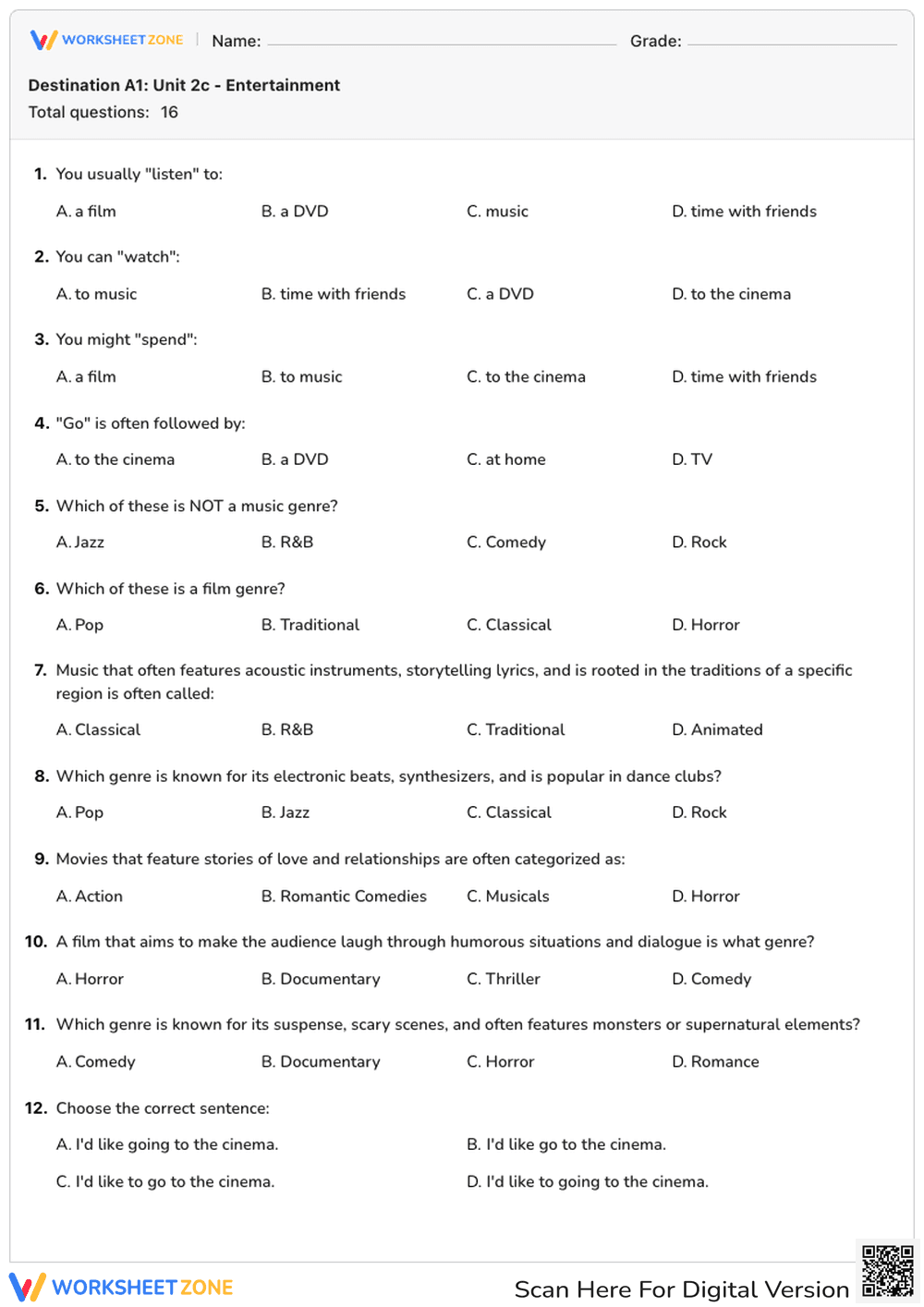
This Grade 4 entertainment vocabulary worksheet helps students master domain-specific language and common verb collocations. By identifying film and music genres and practicing correct sentence structures, learners build the linguistic foundation needed for clear communication. It provides immediate practice with high-frequency phrases used in daily social interactions.
At a Glance
- Grade: 4 · Subject: ELA
- Standard:
CCSS.ELA-LITERACY.L.4.6— Acquire and use accurately grade-appropriate general academic and domain-specific words- Skill Focus: Entertainment Vocabulary & Verb Patterns
- Format: 2 pages · 16 problems · Answer key included · PDF
- Best For: Independent practice or quick formative assessment
- Time: 15–20 minutes
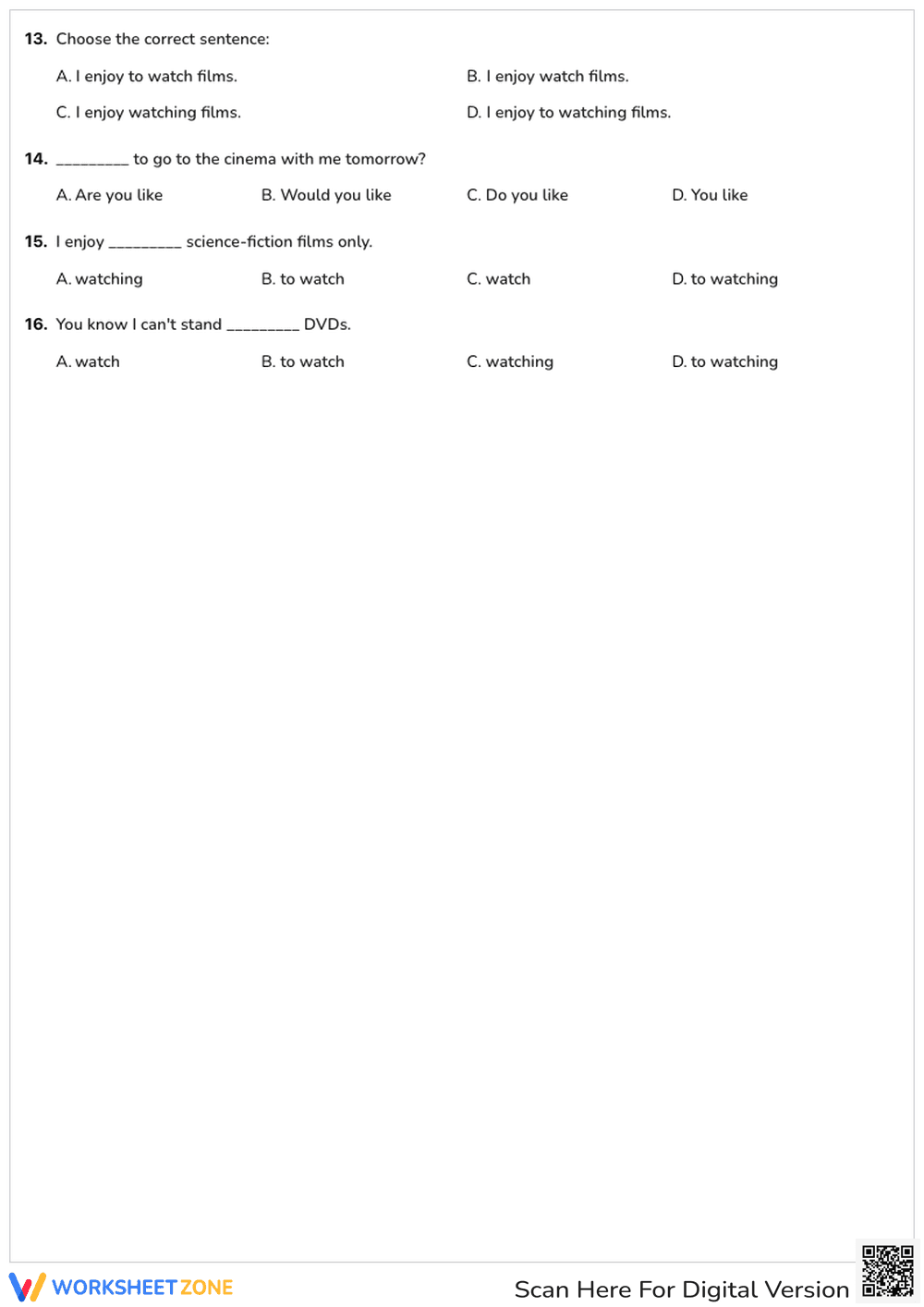
The resource contains 16 multiple-choice questions spread across two pages. The first half focuses on identifying specific music and film genres, such as traditional, classical, and romantic comedies. The second half transitions into grammar, requiring students to select the correct verb forms for phrases like "enjoy watching" and "would like to go." The layout is clean and easy to read, ensuring students stay focused on the linguistic tasks.
This worksheet is designed for a zero-prep classroom environment. Teachers can print the two-page PDF in less than 30 seconds. Distribution takes approximately one minute, and because the format is multiple-choice, reviewing the 16 answers as a whole class can be completed in under five minutes. It is an ideal resource for emergency sub plans or transition periods between core subjects.
Aligned to CCSS.ELA-LITERACY.L.4.6, this worksheet ensures students acquire and use accurately grade-appropriate general academic and domain-specific words and phrases, including those that signal precise actions or emotions. It also supports L.4.1 by reinforcing correct usage of verbal phrases. Both standard codes can be copied directly into lesson plans, IEP goals, or district curriculum mapping tools.
Use this worksheet as an exit ticket after a lesson on hobbies or as a warm-up activity to activate prior knowledge. During instruction, observe if students struggle with the gerund vs. infinitive distinction in questions 12 through 16. Completion typically takes 15 to 20 minutes depending on reading speed, making it a flexible tool for various instructional blocks.
This resource is perfect for Grade 3 and Grade 4 students, as well as English Language Learners (ELL) at the A1 proficiency level. It pairs naturally with a genre-sorting anchor chart or a short reading passage about cinema history to provide context for the vocabulary terms. The multiple-choice format provides enough support for struggling readers while still challenging them to recognize subtle differences in word usage.
According to the RAND AIRS 2024 analysis of instructional materials, structured vocabulary practice that combines domain-specific nouns with functional verb collocations significantly improves reading comprehension scores. This worksheet addresses the CCSS.ELA-LITERACY.L.4.6 standard by requiring students to distinguish between similar entertainment categories and apply grammatical rules to common phrases. By engaging with 16 targeted questions, students move beyond simple recognition to functional application. Research indicates that frequent, low-stakes assessments help solidify word-to-meaning connections in elementary learners. This resource provides the necessary repetition for students to internalize phrases like "go to the cinema" or "listen to music," which are essential for both academic and social ELA proficiency. The inclusion of an answer key allows for immediate feedback, a critical component in the learning cycle for developing writers and speakers.


