


























Views
Downloads
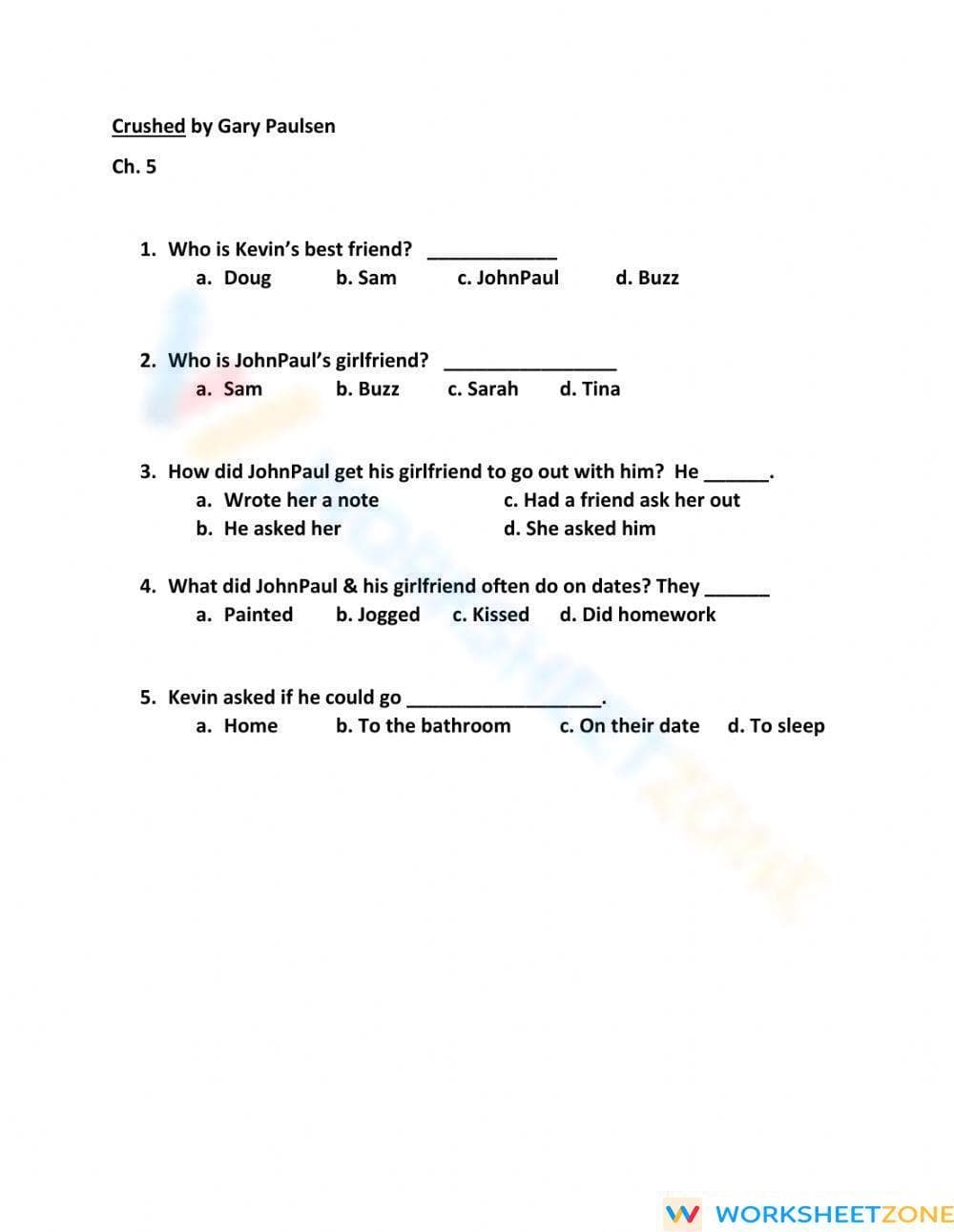

Printable Crushed Ch. 5 Worksheet | Grades 5-8 ELA
Paste this activity's link or code into your existing LMS (Google Classroom, Canvas, Teams, Schoology, Moodle, etc.).
Students can open and work on the activity right away, with no student login required.
You'll still be able to track student progress and results from your teacher account.
This comprehensive reading comprehension worksheet for Chapter 5 of "Crushed" provides students with a targeted opportunity to demonstrate their understanding of key plot developments and character interactions. By engaging with these specific text-based questions, learners strengthen their ability to cite evidence and make logical inferences, ensuring mastery of core literary analysis skills.
At a Glance
- Grade: 5-8 · Subject: ELA Literature
- Standard:
CCSS.ELA-LITERACY.RL.6.1— Cite textual evidence to support analysis of what the text says explicitly- Skill Focus: Literal Comprehension & Recall
- Format: 1 page · 5 problems · Answer key included · PDF
- Best For: Chapter check-ins and reading accountability
- Time: 15–20 minutes
This single-page resource features five carefully crafted multiple-choice questions focusing on the pivotal events of Chapter 5. The layout is clean and distraction-free, allowing students to focus entirely on the text. Each question is designed to test recall of specific details, encouraging students to refer back to the book to verify their answers before selection.
Implementing this resource is designed for maximum teacher efficiency. First, Print the single-page PDF (less than 30 seconds). Second, Distribute the copies to your students as a bell-ringer or exit ticket (1 minute). Finally, Review the answers together using the included key to provide immediate feedback (5 minutes). Total prep time is under 2 minutes, making this an ideal emergency sub-plan addition.
The primary focus of this worksheet is `CCSS.ELA-LITERACY.RL.6.1`, which requires students to cite textual evidence to support analysis of what the text says explicitly. By answering these comprehension questions, students practice the foundational skill of grounding their assertions in the author's words. This resource also supports Grade 5 standards like `CCSS.ELA-LITERACY.RL.5.1` by emphasizing literal recall. Both standard codes can be copied directly into lesson plans, IEP goals, or district curriculum mapping tools.
This worksheet serves as an ideal formative assessment immediately following a shared or independent reading of Chapter 5. Use it to gauge which students have grasped the literal meaning of the text before moving on to deeper thematic analysis. Observe students during completion to identify those struggling with basic recall, which may indicate a need for additional decoding or fluency support.
This resource is tailored for middle school students in Grades 5 through 8 who are reading "Crushed" as part of a literature unit. It is particularly effective for students who benefit from structured, low-stakes assessments to build confidence in their reading abilities. Pair this worksheet with a character chart or a vocabulary word bank to provide extra support for English Language Learners or students with processing challenges.
Effective reading comprehension instruction relies on frequent, low-stakes monitoring of student understanding to prevent cumulative learning gaps. According to RAND AIRS 2024, the use of targeted comprehension checks significantly improves retention of narrative details and supports the development of complex mental models during independent reading. This Chapter 5 worksheet for "Crushed" aligns with evidence-based practices for literacy instruction by isolating specific text segments for analysis. By focusing on `CCSS.ELA-LITERACY.RL.6.1`, the resource ensures that students are not only reading the words but are actively processing the information to build a coherent understanding of the story's progression. This systematic approach to literal comprehension provides the necessary foundation for higher-order thinking tasks, such as theme identification and character analysis, which are essential for meeting rigorous state and national standards in English Language Arts.


