


























Views
Downloads

Built for Thrills Printable Response Questions | Grade 3
Paste this activity's link or code into your existing LMS (Google Classroom, Canvas, Teams, Schoology, Moodle, etc.).
Students can open and work on the activity right away, with no student login required.
You'll still be able to track student progress and results from your teacher account.
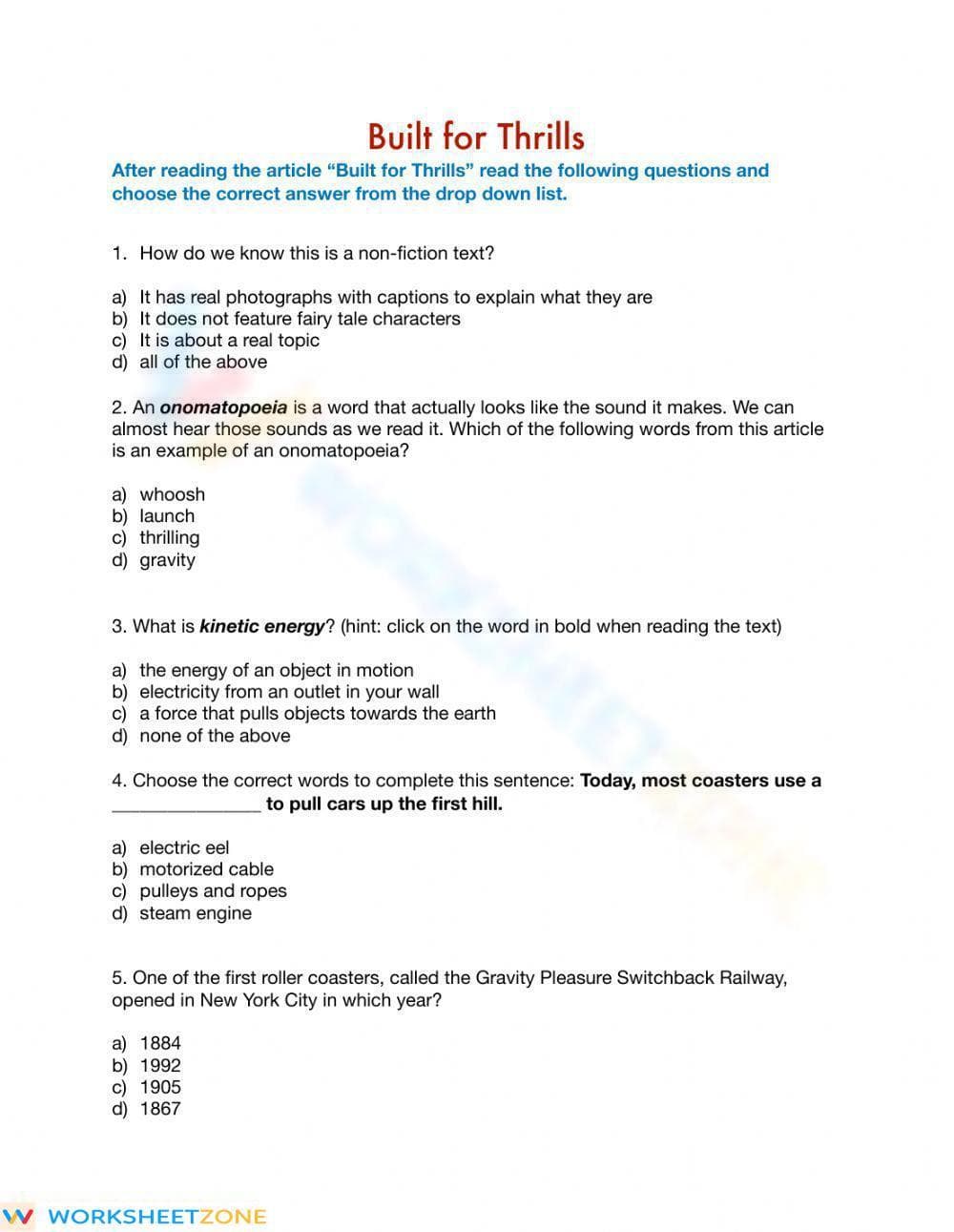
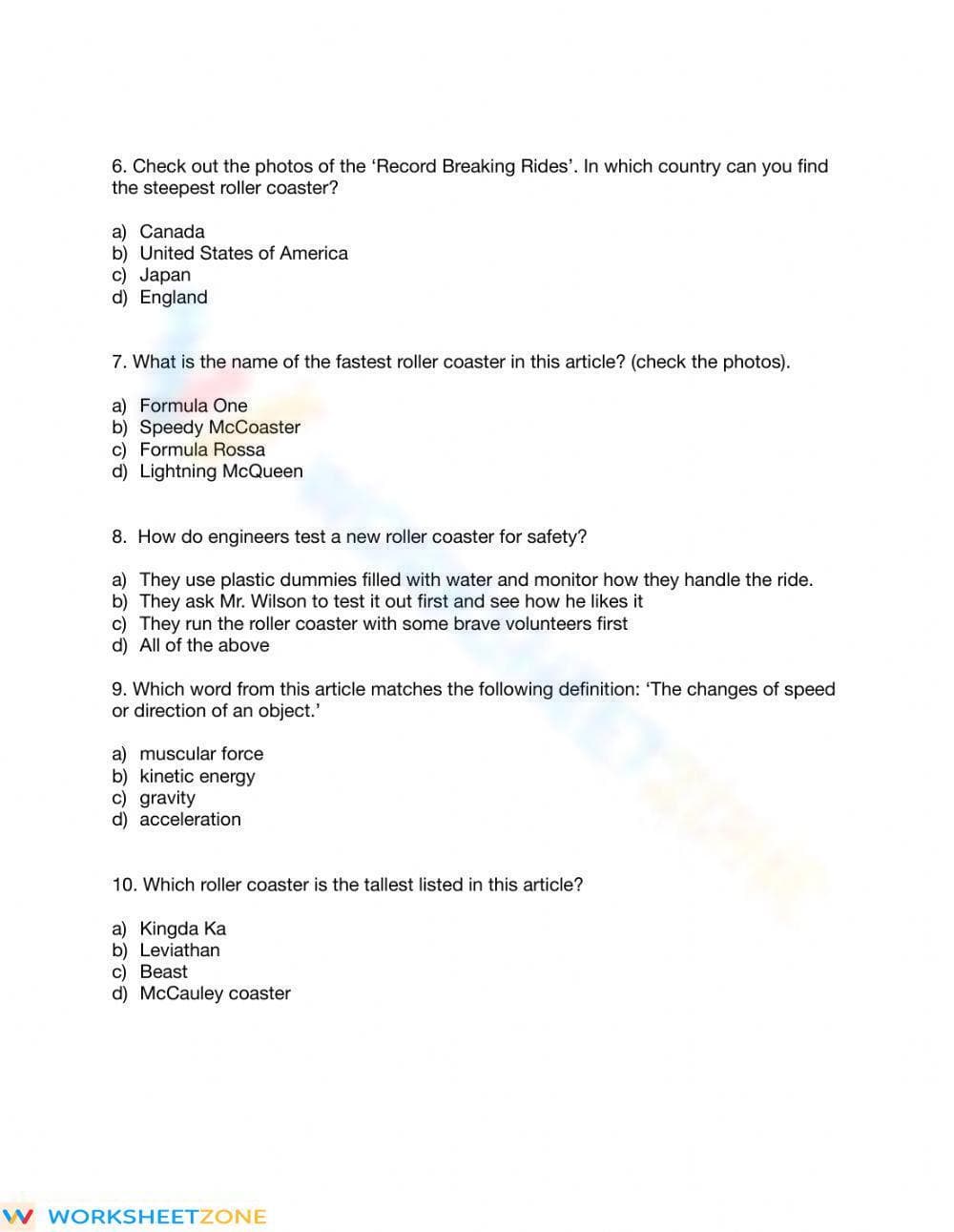
This Grade 3 reading comprehension worksheet provides a comprehensive set of response questions for the informational text 'Built for Thrills.' By engaging with these structured prompts, students demonstrate their ability to extract specific details and technical vocabulary from a non-fiction article.
At a Glance
- Grade: 3 · Subject: ELA
- Standard:
CCSS.ELA-LITERACY.RI.3.1— Ask and answer questions to demonstrate understanding of an informational text by referring to details- Skill Focus: Informational Text Comprehension
- Format: 2 pages · 10 problems · Answer key included · PDF
- Best For: Literacy centers and formative assessment
- Time: 15–25 minutes
This informational text response packet consists of two organized pages containing ten high-quality multiple-choice questions. The worksheet covers a diverse range of literacy and science-integrated skills, including identifying non-fiction text features, recognizing onomatopoeia, and defining domain-specific vocabulary like kinetic energy and acceleration. A clear answer key is provided for rapid grading.
The zero-prep design allows teachers to implement this activity in under two minutes. First, print the two-page document or upload it to your digital classroom platform. Second, distribute the questions to students following their reading of the 'Built for Thrills' article. Finally, review the answers using the included key for immediate feedback.
The primary focus of this worksheet is `CCSS.ELA-LITERACY.RI.3.1`, which requires students to ask and answer questions to demonstrate understanding of a text, referring explicitly to the text as the basis for the answers. Additionally, it supports vocabulary acquisition through the identification of figurative language and technical terms. Both standard codes can be copied directly into lesson plans, IEP goals, or district curriculum mapping tools.
Utilize this worksheet as a formative assessment after a whole-group reading of the article to gauge individual comprehension levels. During the activity, observe students as they refer back to the text to locate specific evidence for questions regarding roller coaster history and engineering. This resource typically takes fifteen to twenty-five minutes to complete.
This resource is designed for Grade 3 and Grade 4 students who are developing their informational text reading stamina. It provides necessary scaffolding for struggling readers through clear multiple-choice options while challenging advanced learners with technical vocabulary. It pairs naturally with an anchor chart on non-fiction text features or a science lesson on simple machines.
Research conducted by Fisher & Frey (2014) highlights the critical importance of close reading and evidence-based questioning in developing student literacy. This 'Built for Thrills' worksheet applies these principles by requiring students to interact deeply with informational content through the CCSS.ELA-LITERACY.RI.3.1 standard. By focusing on explicit details and domain-specific vocabulary, the resource helps bridge the gap between basic reading and complex text analysis. The structured format of the ten questions ensures that students practice identifying evidence-based answers, which is a key predictor of success on standardized ELA assessments. This alignment with rigorous academic standards provides teachers with a reliable tool for tracking student progress toward informational text mastery. Furthermore, the inclusion of science-related topics such as kinetic energy and engineering safety tests reflects a multidisciplinary approach to education, as recommended in the ScienceDirect TpT Analysis. This standalone summary demonstrates how the resource effectively supports both reading fluency and analytical thinking skills in the elementary classroom environment.


