


























Views
Plays

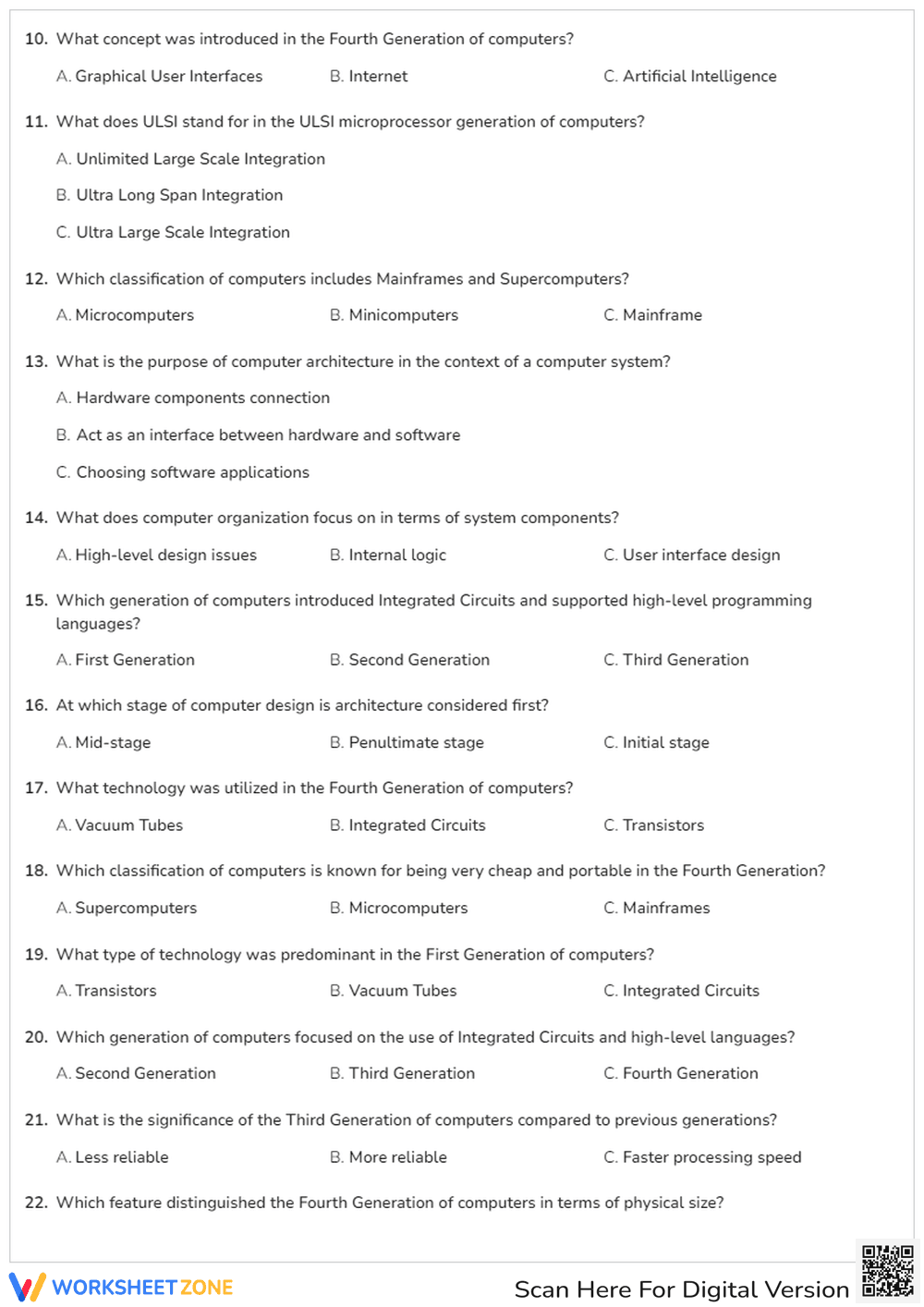


Computer Architecture Reviewer | Essential College Worksheet
Paste this activity's link or code into your existing LMS (Google Classroom, Canvas, Teams, Schoology, Moodle, etc.).
Students can open and work on the activity right away, with no student login required.
You'll still be able to track student progress and results from your teacher account.
This comprehensive computer architecture reviewer provides students with a structured path to mastering the fundamental concepts of hardware organization and system design. By engaging with 30 targeted multiple-choice questions, learners demonstrate their ability to distinguish between logical execution and physical implementation. This resource ensures students can accurately identify technological milestones from vacuum tubes to modern ULSI microprocessors.
At a Glance
- Grade: College · Subject: Computer Science
- Standard:
ACM-CS-AR.1— Explain the evolution and organization of computer architecture components- Skill Focus: Hardware Generations
- Format: 3 pages · 30 problems · PDF
- Best For: Exam Prep
- Time: 30–45 minutes
What's Inside
The worksheet consists of 30 high-quality multiple-choice questions spread across 3 clearly formatted pages. The content is logically sequenced to cover the defining attributes of computer architecture, the specific focus of computer organization, and a detailed chronological survey of computer generations. Students will encounter questions regarding vacuum tubes, transistors, integrated circuits, and the transition to VLSI and ULSI technologies.
Zero-Prep Workflow
This reviewer is designed for immediate classroom implementation with a total teacher preparation time of under 2 minutes. First, Print the three-page PDF document for your cohort (30 seconds). Second, Distribute the materials as a quiet-start activity or a formal practice quiz to gauge student readiness for module assessments (30 seconds). Finally, Review the answers collectively to address misconceptions regarding computer generations or the distinction between architecture and organization (1 minute). This process makes the worksheet an ideal candidate for emergency sub plans or exam review.
Standards Alignment
This resource is aligned with the `ACM-CS-AR.1` standard, which focuses on the "Digital Logic and Digital Systems" domain. Students must "explain the organization of the classical von Neumann machine and its major functional units." Both standard codes can be copied directly into lesson plans, IEP goals, or district curriculum mapping tools.
How to Use It
This worksheet is best utilized during the "Review" phase of an introductory computer organization module. Assign it as a formative assessment after covering the history of computing to identify which students struggle with the nuances of hardware evolution. Expected completion time ranges from 30 to 45 minutes. For a collaborative approach, have students justify their answers in small groups.
Who It's For
This material is specifically designed for college-level computer science and information technology students. It serves as an excellent bridge between introductory hardware lectures and advanced systems programming. It pairs naturally with a standard computer organization textbook. The clear, academic language makes it suitable for both traditional learners and those requiring structured review materials.
According to the RAND AIRS 2024 report on technical education, structured retrieval practice through multiple-choice assessments significantly improves long-term retention of complex hardware concepts. This worksheet aligns with the ACM-CS-AR.1 standard, which requires students to distinguish between computer architecture and organization while identifying the evolution of circuit technology from vacuum tubes to ULSI microprocessors. Research from Fisher & Frey (2014) suggests that "Reviewer" style documents serve as critical scaffolds during the transition from direct instruction to independent mastery in high-stakes technical fields. By providing 30 targeted questions, this resource ensures that learners can identify the defining attributes of logical execution and physical realization within modern computing systems. The inclusion of specific historical milestones, such as Integrated Circuits and VLSI, provides the necessary context for understanding current hardware limitations and future engineering possibilities in computer science.


