































6.NS.B.3 Quiz: Add & Subtract Decimals — Grade 6 Aligned

Paste this activity's link or code into your existing LMS (Google Classroom, Canvas, Teams, Schoology, Moodle, etc.).
Students can open and work on the activity right away, with no student login required.
You'll still be able to track student progress and results from your teacher account.
Assess Decimal Operations with a Standards-Aligned Quiz
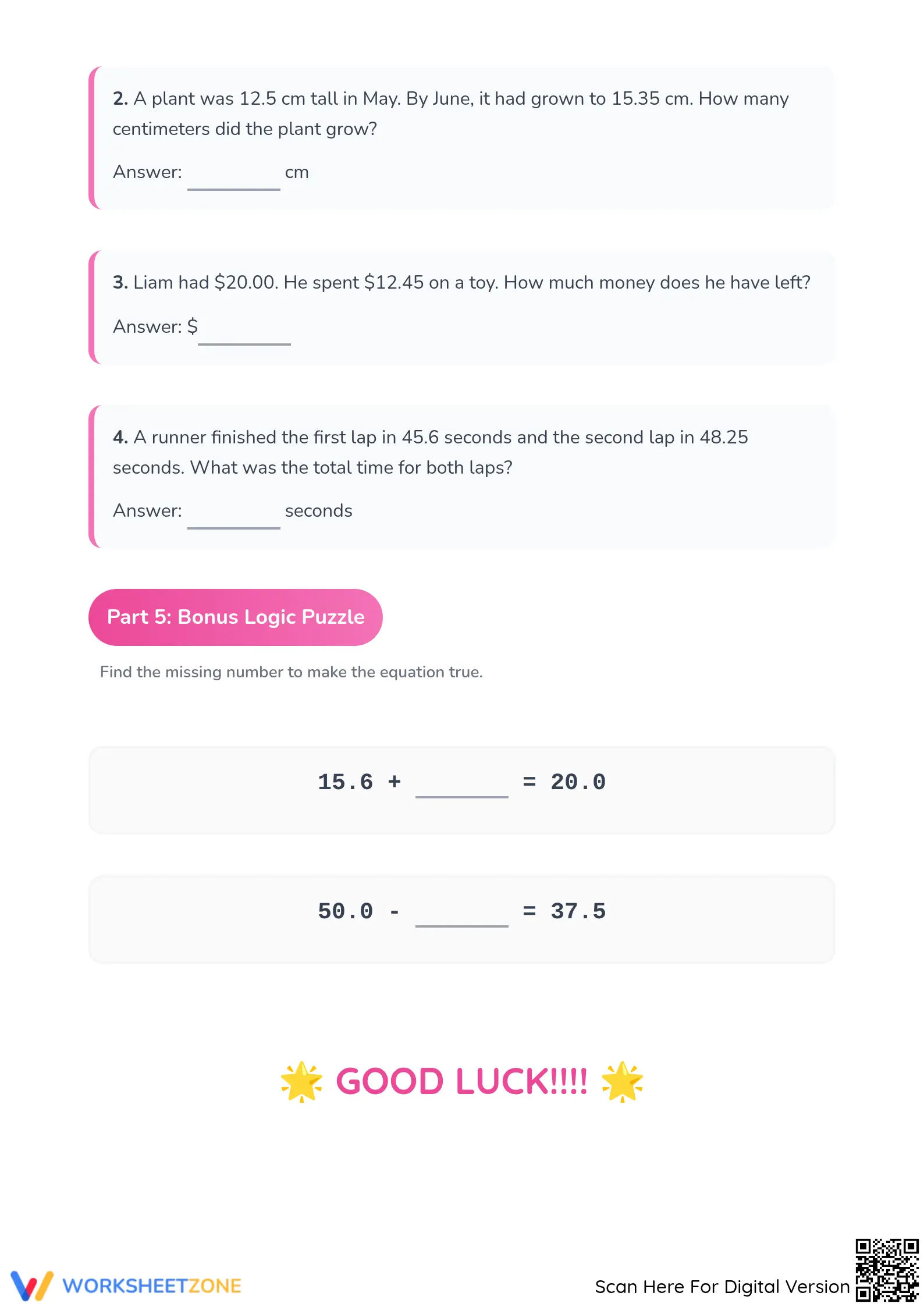
This Grade 6 math quiz provides targeted assessment of adding and subtracting multi-digit decimals. Students will solve 8 problems, including computational and word problems, demonstrating their fluency with the standard algorithm. It's a straightforward tool to gauge student understanding of CCSS.MATH.CONTENT.6.NS.B.3 and identify areas needing review.
At a Glance
- Grade: 6 · Subject: Math
- Standard:
CCSS.MATH.CONTENT.6.NS.B.3— Fluently add and subtract multi-digit decimals using the standard algorithm.- Skill Focus: Adding and Subtracting Decimals
- Format: 2 pages · 8 problems · Answer key included · PDF
- Best For: Formative assessment, quiz, or skill review
- Time: 15–25 minutes
What's Inside
This resource includes a two-page printable quiz and a one-page answer key. The quiz presents eight problems focused on adding and subtracting decimals. The first four problems are direct computation, while the last four are word problems requiring students to apply their skills in context. The layout is clean and provides ample space for student work.
Evidence of Mastery
This quiz serves as a direct measure of student proficiency with the core components of standard CCSS.MATH.CONTENT.6.NS.B.3. The eight problems are structured to assess both procedural fluency and application. The initial computation questions check for accurate use of the standard algorithm for addition and subtraction of decimals. The subsequent word problems require students to correctly interpret scenarios, set up the problem, and solve. While no rubric is included, scores on this quiz provide clear evidence for standards-based gradebooks and can inform instructional next steps.
Standards Alignment
This worksheet is directly aligned with the following Common Core State Standard:CCSS.MATH.CONTENT.6.NS.B.3: Fluently add, subtract, multiply, and divide multi-digit decimals using the standard algorithm for each operation.
While this quiz focuses on addition and subtraction, it addresses a core fluency requirement of the standard. The standard code can be copied directly into lesson plans, IEP goals, or district curriculum mapping tools.
How to Use It
Use this quiz as a formative assessment after teaching decimal operations. It's an effective way to check for understanding before moving on to multiplication and division. For a quick check-in, have students complete the first four problems independently at the start of class. As you circulate, observe how students align decimal points; this is a key indicator of conceptual understanding. The entire worksheet should take most students between 15 and 25 minutes to complete.
Who It's For
This quiz is designed for 6th-grade math students working on the Number System strand. It is also suitable for 7th-grade students who need a review of decimal operations or for advanced 5th graders. For students needing support, consider providing a number line or completing the first problem together as a class. This quiz pairs well with a lesson on place value or money math to ground the abstract calculations.
This Grade 6 assessment provides focused practice on CCSS.MATH.CONTENT.6.NS.B.3, requiring students to fluently add and subtract multi-digit decimals. The worksheet's design, which combines procedural practice with contextual word problems, supports the development of both computational skill and mathematical reasoning. According to research from RAND AIRS 2024, assessments that isolate specific skills within a standard are critical for effective formative feedback and targeted instruction. By providing clear evidence of a student's ability to apply the standard algorithm, this quiz allows teachers to make data-informed decisions. Its 8 problems offer a reliable snapshot of student mastery, helping to ensure that foundational decimal computation skills are secure before students advance to more complex algebraic concepts, a progression supported by findings on instructional scaffolding. This tool serves as a practical application of research-based assessment principles in the classroom.


