


























Views
Plays

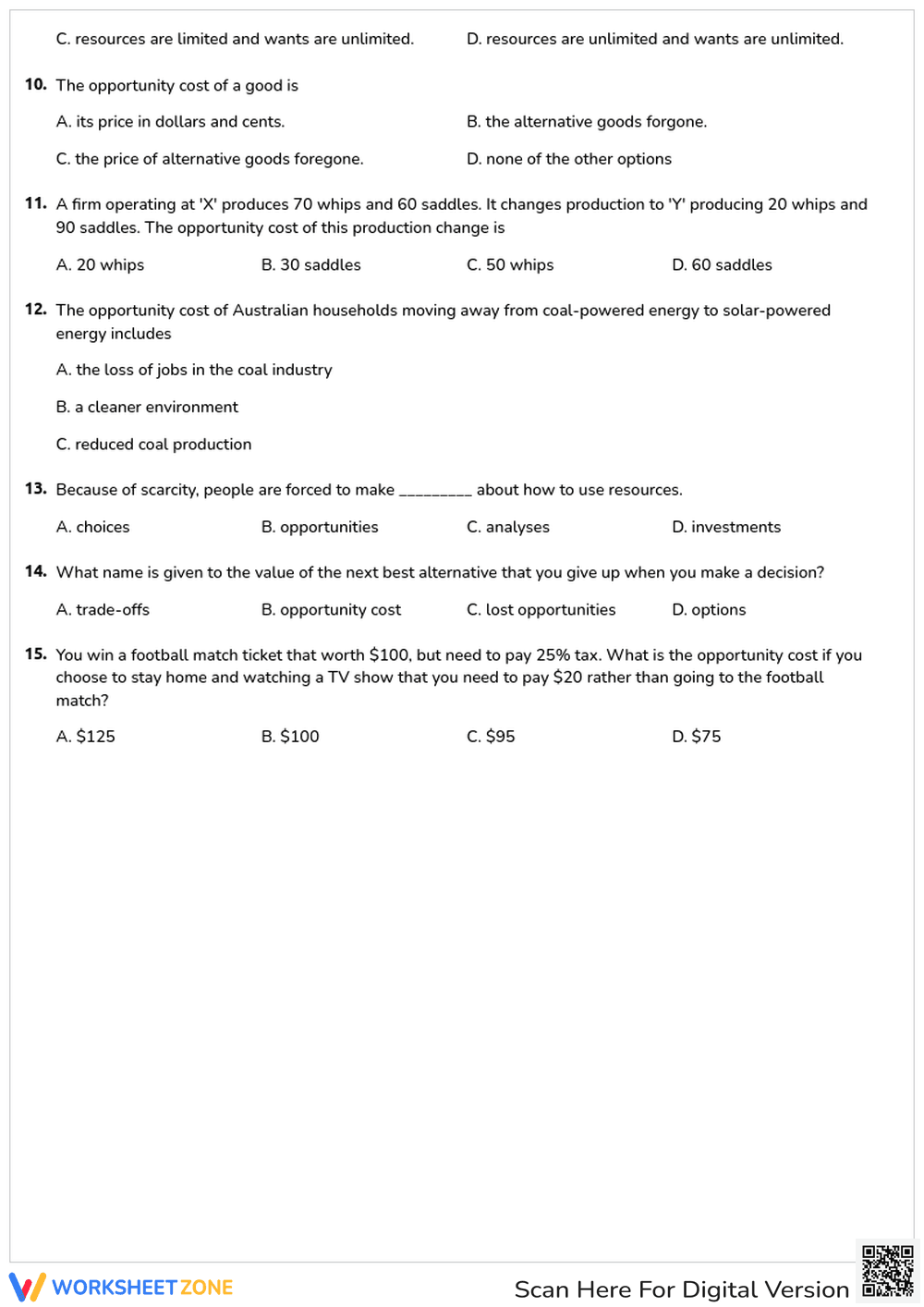

Opportunity Cost Worksheet | Grade 4 Printable Quiz
Paste this activity's link or code into your existing LMS (Google Classroom, Canvas, Teams, Schoology, Moodle, etc.).
Students can open and work on the activity right away, with no student login required.
You'll still be able to track student progress and results from your teacher account.
This Grade 4 economics worksheet helps students master the concepts of opportunity cost, scarcity, and trade-offs. By analyzing real-world scenarios, learners will identify what is given up when a choice is made, building foundational financial literacy and critical thinking skills essential for everyday decision-making.
At a Glance
- Grade: 4 · Subject: Social Studies
- Standard:
D2.Eco.1.3-5— Compare the benefits and costs of individual choices- Skill Focus: Identifying opportunity cost
- Format: 2 pages · 15 problems · Answer key included · PDF
- Best For: Formative assessment or independent practice
- Time: 15–20 minutes
This two-page resource features 15 multiple-choice questions designed to test students' understanding of basic economic principles. The questions range from simple vocabulary definitions, like scarcity and trade-offs, to applied word problems where students must determine the opportunity cost of specific scenarios, such as choosing between a vacation and a swimming pool. A complete answer key is included for quick and accurate grading.
Zero-Prep Workflow
This worksheet is designed for immediate classroom use with minimal teacher preparation:
- Print (1 minute): Simply print the two-page PDF and the accompanying answer key.
- Distribute (1 minute): Hand out the quiz as a standalone assignment, morning work, or assessment.
- Review (3 minutes): Use the provided answer key to quickly grade submissions or guide a whole-class review session.
With under two minutes of total prep time, this resource is an excellent addition to any emergency sub plan or busy teaching schedule.
Standards Alignment
This resource is aligned to the C3 Framework standard D2.Eco.1.3-5, which requires students to compare the benefits and costs of individual choices. It also supports broader social studies objectives related to understanding how scarcity forces individuals and communities to make economic decisions. Both standard codes can be copied directly into lesson plans, IEP goals, or district curriculum mapping tools.
How to Use It
This worksheet is highly versatile and fits easily into various instructional moments. Use it as a formative assessment after direct instruction on basic economics to gauge class comprehension. Alternatively, assign it as independent practice or homework to reinforce the concepts of scarcity and trade-offs. As a formative observation tip, watch how students approach the word problems; if they struggle to identify the next best alternative, they may need a quick reteach on the definition of opportunity cost. Students typically complete this activity in 15 to 20 minutes.
Who It's For
This resource is primarily designed for third, fourth, and fifth-grade students studying introductory economics or financial literacy. The clear, multiple-choice format provides built-in scaffolding for learners who benefit from structured options, making it accessible for diverse learning needs. It pairs perfectly with an anchor chart defining economic terms or a direct instruction lesson on community decision-making.
Understanding economic trade-offs at an early age is crucial for developing long-term financial literacy and responsible decision-making. Aligned with D2.Eco.1.3-5, this resource helps students compare the benefits and costs of individual choices in relatable contexts. According to a RAND AIRS 2024 study, integrating practical economic scenarios into elementary social studies significantly improves students' ability to evaluate everyday decisions and understand resource allocation. By practicing these skills through relatable word problems, learners build a robust cognitive framework for analyzing scarcity and opportunity cost. This foundational knowledge not only meets core social studies requirements but also prepares students for more complex civic and economic reasoning in middle school and beyond. Providing structured, scenario-based practice ensures that abstract economic concepts become tangible, memorable, and actionable for young learners.


